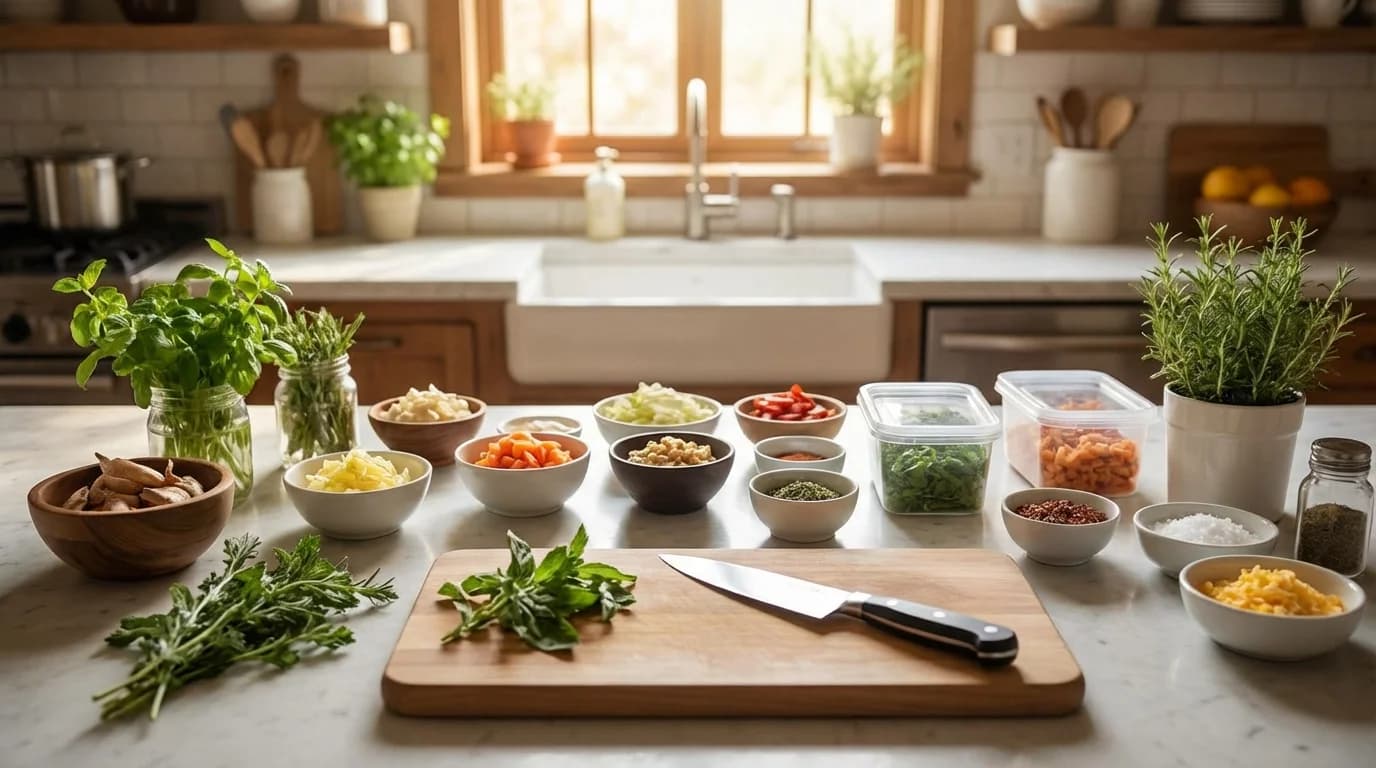
Mise en Place Explained: The French Technique That Transforms Cooking
If you've ever watched a cooking show and marveled at how chefs have every ingredient pre-measured in tiny bowls, you've witnessed mise en place in action. This French culinary term, pronounced "meez-ahn-plahs," literally means "everything in its place." It's the professional technique of preparing and organizing all ingredients before you start cooking—and it's the single habit that will most dramatically improve your home cooking experience.
What is Mise en Place?
Mise en place is a systematic approach to cooking that involves:
Before cooking begins:
- Reading the entire recipe thoroughly
- Gathering all ingredients
- Measuring and preparing all ingredients (chopping, slicing, mincing)
- Organizing ingredients in the order they'll be used
- Gathering all necessary equipment and tools
- Preparing your workspace
The result: When it's time to cook, you simply execute the recipe without stopping to chop onions, hunt for spices, or realize you're missing a key ingredient.
Why Mise en Place Matters
1. Prevents Mistakes
Common scenarios prevented:
- Forgetting to add an ingredient
- Realizing you're out of something mid-recipe
- Adding ingredients in the wrong order
- Burning garlic while you frantically chop vegetables
2. Reduces Stress
Mental benefits:
- No multitasking anxiety
- Clear, linear process
- Confidence that everything you need is ready
- Focus on technique rather than logistics
3. Improves Timing
Cooking flows better when:
- Everything goes in at the right moment
- No rushed chopping while food overcooks
- Better coordination of multiple components
- Professional-level timing precision
4. Elevates Results
Quality improves because:
- Consistent knife work (not rushed)
- Proper cooking times (not interrupted)
- Better flavor development
- More attention to technique
5. Makes Cooking More Enjoyable
The process becomes:
- Meditative rather than frantic
- Creative rather than chaotic
- Satisfying rather than stressful
- Actually fun instead of purely functional
The Mise en Place Process: Step by Step
Step 1: Read the Entire Recipe
Before you do anything else:
- Read from start to finish
- Note any confusing steps or unfamiliar terms
- Check for make-ahead components ("marinate overnight")
- Understand the timeline (1 hour of cooking, 30 minutes of resting)
- Identify points where you'll be busy (can't walk away)
Red flags to catch:
- "In a bowl you prepared earlier" (prepare it now)
- Ingredients listed in the instructions but not the ingredient list
- Special equipment requirements
- Extended passive time (rising, chilling, marinating)
Step 2: Gather All Ingredients
The inventory check:
- Pull everything from the pantry, fridge, and freezer
- Check that you have enough of each item
- Verify ingredients aren't expired
- Make substitutions NOW if necessary, not mid-cooking
Pro tip: Physically set items on the counter. Visual confirmation prevents "I thought I had that" moments.
Step 3: Prepare Each Ingredient
Measure and prep as specified:
- Chop all vegetables to specified sizes
- Mince garlic and ginger
- Measure spices, oils, liquids
- Grate cheese
- Open cans
- Juice citrus
- Toast nuts
- Bring ingredients to room temperature if required
Uniform sizes matter:
- Consistent pieces cook evenly
- Follow recipe specifications ("1/4-inch dice")
- Learn proper knife skills for efficiency
- Master dicing onions properly
Step 4: Organize by Cooking Order
Arrange ingredients in sequence:
- Group items that go in together
- Separate things added at different times
- Place first ingredients closest to the stove
- Use small bowls, ramekins, or prep containers
Example for stir-fry:
- Bowl 1: Aromatics (garlic, ginger) - goes in first
- Bowl 2: Vegetables - goes in second
- Bowl 3: Protein - goes in third
- Bowl 4: Sauce ingredients - goes in fourth
- Bowl 5: Garnishes - goes on at the end
Step 5: Gather Equipment
Have tools ready:
- Correct pan/pot (and lid if needed)
- Stirring utensils
- Measuring cups/spoons
- Thermometer
- Timer
- Plates for finished food
- Serving utensils
Pre-heat when necessary:
- Oven
- Pans (pan-searing requires preheating)
- Grill
Step 6: Prepare Your Workspace
Set yourself up for success:
- Clear and clean counters
- Have a trash bowl for scraps
- Damp towel under cutting board (prevents slipping)
- Clean towel for wiping hands
- Clear path between prep area and stove
Step 7: Cook
Now the fun part:
- Follow recipe with confidence
- Add ingredients in order
- Focus on technique and timing
- Enjoy the smooth, stress-free process
Mise en Place for Different Cooking Scenarios
Quick Weeknight Dinners
Modified approach for speed:
- Full mise en place for complex recipes
- Minimal prep for simple recipes (one-pot pasta, simple sautés)
- Prep while other components cook (dice onions while pasta boils)
Time-saving tip: Prep ingredients during the weekend for quick weeknight meals throughout the week.
Complex Recipes
Essential for:
- Multi-component dishes
- Precise timing requirements (soufflés, stir-fries)
- Dishes you're making for the first time
- Entertaining (no stress when guests arrive)
Meal Prep
Batch mise en place:
- Prepare all ingredients for multiple recipes at once
- Wash and chop all vegetables together
- Cook proteins together
- Portion into containers
Learn more about meal prep strategies.
Baking
Critical for success:
- Baking is chemistry—precision matters
- Measure everything before starting
- Bring ingredients to room temperature
- Prep pans (grease, line with parchment)
Tools and Containers for Mise en Place
Essential items:
Small bowls/ramekins (2-4 oz):
- For minced garlic, spices, small amounts
- Glass or ceramic (can see contents)
- Stackable for storage
Medium bowls (1-2 cups):
- For chopped vegetables, measured liquids
- Enough for most prep tasks
Prep containers with lids:
- For make-ahead mise en place
- Stack in refrigerator
- Can go from prep to cooking to storage
Sheet pans:
- Arrange multiple small bowls
- Easy to transport from counter to stove
- Catches spills
Bench scraper:
- Transfer chopped ingredients to bowls
- Clean workspace between tasks
Trash bowl:
- Keep one at your workspace
- Eliminate trips to garbage can
- Classic restaurant technique
Common Mistakes and How to Avoid Them
Mistake 1: Skipping the Recipe Read-Through
Problem: Discovering unexpected steps or missing ingredients mid-cooking
Fix: Always read entirely before starting. No exceptions.
Mistake 2: Over-Prepping Simple Dishes
Problem: Wasting time on unnecessary prep for basic recipes
Fix: Use judgment. Simple 30-minute meals don't need extensive mise en place.
Mistake 3: Prepping Too Far in Advance
Problem: Ingredients oxidize, dry out, or lose freshness
Fix: Prep immediately before cooking, or within 1-2 hours. For longer storage, cover tightly and refrigerate.
Mistake 4: Not Organizing by Cooking Order
Problem: Fumbling for ingredients, adding things out of sequence
Fix: Arrange left to right (or in numbered groups) in the order they'll be used.
Mistake 5: Forgetting Equipment
Problem: Realizing you need a thermometer/grater/whisk mid-recipe
Fix: Include equipment gathering in your mise en place routine.
Mistake 6: Insufficient Workspace
Problem: Cluttered counters, no room to work
Fix: Clear and clean counters before starting. Put away items you won't need.
Mise en Place for Small Kitchens
Strategies when space is limited:
Vertical organization:
- Stack bowls that aren't immediately needed
- Use sheet pans to create layers
Sequential prepping:
- Prep ingredients that go in later while earlier ones cook
- Clean as you go to free up space
Multipurpose containers:
- Use measuring cups as both measuring tools and prep bowls
- Prep directly in cooking vessel when possible
Prioritize critical items:
- Full mise en place for time-sensitive items (garlic, aromatics)
- Prep later additions while earlier ingredients cook
Teaching Mise en Place to Beginners
Start simple:
- Choose a basic recipe (stir-fries work well)
- Practice full mise en place
- Experience how smoothly cooking flows
- Build the habit gradually
Make it a game:
- Time yourself—how fast can you prep?
- Challenge: Don't start cooking until everything is ready
- Notice stress reduction
Professional Applications of Mise en Place
Beyond ingredients:
Professional kitchens apply mise en place as a philosophy:
- Mental preparation and focus
- Organized workspace
- Systematic approach to all tasks
- Clean as you go
- Respect for tools and ingredients
- Efficiency and excellence
Life applications:
- Project planning
- Packing for trips
- Home organization
- Any task requiring multiple components
Mise en Place and Clean-as-You-Go
Complementary practices:
During prep:
- Wipe counters between ingredients
- Wash cutting board after raw meat
- Rinse bowls and measuring tools as you finish with them
- Put away ingredients after measuring
Result: Minimal cleanup after eating because most is done during cooking.
Digital Mise en Place
Modern tools:
Recipe apps:
- Generate shopping lists
- Scale ingredients automatically
- Set timers for each step
Notes:
- Keep a running list of needed equipment
- Note successful substitutions
- Track prep times for future reference
Time Investment vs. Time Saved
Reality check:
Mise en place adds time upfront:
- 10-15 minutes for simple recipes
- 20-30 minutes for complex recipes
But saves time during cooking:
- Faster execution
- No interruptions
- No mistakes requiring fixes
- Less cleanup
Net result: Comparable or less total time, dramatically less stress.
When to Skip Mise en Place
Appropriate shortcuts:
Very simple recipes:
- One-pot pasta dishes with few ingredients
- Recipes where ingredients cook sequentially with enough time to prep between
Experienced cooks with familiar recipes:
- You've made it dozens of times
- Timing is second nature
- You can multitask comfortably
Judgment call: If you're considering skipping it, you probably shouldn't.
Building the Mise en Place Habit
Week 1: Choose one recipe, practice full mise en place Week 2: Apply to two recipes this week Week 3: Make it standard for any new or complex recipe Week 4: Notice how natural it has become
Long-term: Mise en place becomes automatic, and cooking without it feels chaotic.
Mise en Place for Specific Techniques
Stir-frying:
- Absolutely essential (timing is tight)
- Everything must be ready before pan gets hot
- See stir-fry techniques
Searing:
- Critical for success
- No time to prep once searing begins
- Learn pan-searing techniques
Soup-making:
- Helpful but less critical
- Can prep aromatics while stock heats
- See soup-making guide
Slow cooking:
- Minimal mise en place needed
- Ingredients cook for hours
- More forgiving timing
- Learn slow cooking tips
Conclusion
Mise en place is more than a technique—it's a mindset that transforms cooking from a chaotic scramble into a controlled, enjoyable process. The investment of 10-20 minutes upfront pays dividends in stress reduction, improved results, and genuine enjoyment of cooking.
Start by applying mise en place to one recipe this week. Experience how smoothly everything flows when ingredients are prepared and organized. Notice how much more you enjoy cooking when you're not frantically searching for ingredients or burning garlic while you dice onions.
With repetition, mise en place becomes habit. You'll wonder how you ever cooked without it. Whether you're making quick weeknight dinners, complex braised dishes, or elaborate meal prep, this single practice elevates every cooking experience from start to finish.
About myrecipe
myrecipe helps families save, organize, and share their favorite recipes in one place. Plan meals, create shopping lists, and preserve your culinary traditions.
Start Organizing Recipes