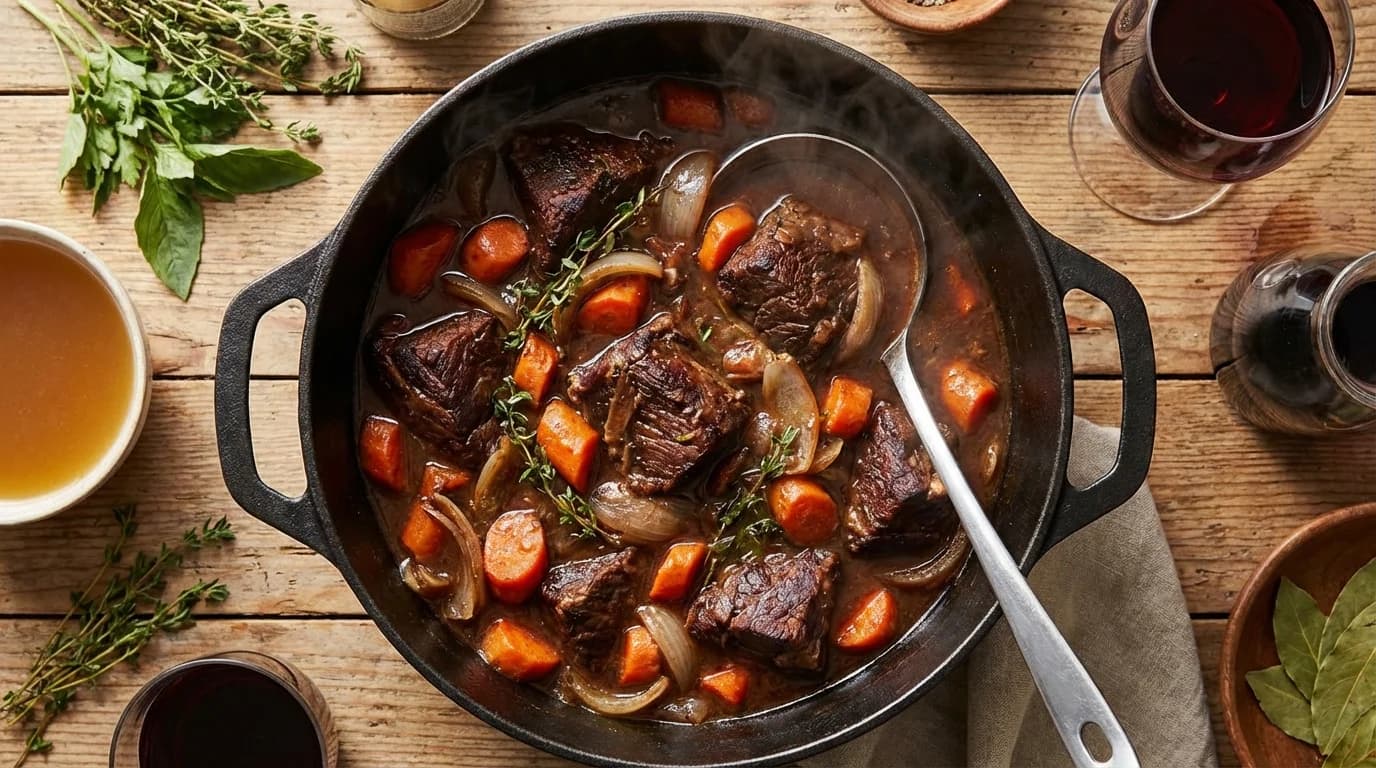
Braising Meat for Beginners: Complete Guide to Tender, Flavorful Results
Braising is a transformative cooking technique that turns tough, inexpensive cuts of meat into fall-apart tender, deeply flavorful dishes. Through the combination of searing, slow cooking in liquid, and patience, braising breaks down connective tissue and collagen, creating succulent results that taste like they required far more skill than they actually did. This comprehensive guide will teach you everything you need to know to braise meat perfectly every time.
What is Braising?
Braising is a two-step cooking method:
Step 1: Searing - Brown the meat at high heat to develop a flavorful crust and fond (browned bits) on the pan bottom.
Step 2: Slow cooking in liquid - The seared meat cooks slowly (usually in the oven) partially submerged in liquid, breaking down tough fibers and creating tender, flavorful results.
The magic happens during the long, slow cook. Connective tissues (collagen) dissolve into gelatin, which gives braised dishes their luxurious, silky texture and rich mouthfeel. This process requires time and gentle heat—you can't rush it.
Why Braise? The Benefits
Transforms tough cuts: Braising makes inexpensive, tough cuts (chuck roast, short ribs, pork shoulder) incredibly tender.
Develops deep flavors: The browning step and long cooking create complex, layered flavors impossible to achieve with quick-cooking methods.
Mostly hands-off: After the initial searing, braising requires minimal attention—perfect for batch cooking and meal prep.
One-pot convenience: Many braised dishes cook the meat and vegetables together, reducing cleanup.
Forgiving technique: Braising is hard to mess up. An extra 30 minutes won't ruin the dish.
Budget-friendly: The best cuts for braising are typically the least expensive, making this technique perfect for budget-friendly cooking.
Best Cuts for Braising
Look for cuts with:
- Plenty of connective tissue (collagen)
- Good marbling (intramuscular fat)
- Comes from well-used muscles (shoulder, legs, neck)
Beef:
- Chuck roast (shoulder)
- Short ribs
- Brisket
- Oxtail
- Beef shanks
- Bottom round
Pork:
- Pork shoulder (Boston butt)
- Pork belly
- Country-style ribs
- Pork shanks
Lamb:
- Lamb shanks
- Lamb shoulder
- Lamb neck
Poultry:
- Chicken thighs (bone-in, skin-on)
- Chicken legs
- Duck legs
- Turkey thighs
Note: Lean cuts (chicken breast, pork tenderloin, beef tenderloin) don't benefit from braising—they become dry and stringy. These cuts are better for quick-cooking methods like pan-searing.
Essential Equipment
Dutch oven: The ideal braising vessel. Heavy, holds heat evenly, goes from stovetop to oven, and retains moisture. 5-7 quart size handles most recipes.
Alternatives:
- Heavy-bottomed oven-safe pot with tight-fitting lid
- Large, deep skillet with lid (for smaller braises)
- Slow cooker (see adaptation notes below)
- Instant Pot (requires technique adjustments)
Other helpful tools:
- Tongs for turning meat
- Instant-read thermometer
- Wooden spoon for scraping fond
- Fine-mesh strainer for sauce
The Basic Braising Method
This fundamental technique applies to virtually any braised dish:
Step 1: Prepare the Meat
- Remove meat from refrigerator 30-60 minutes before cooking (room temperature meat sears better)
- Pat completely dry with paper towels—moisture prevents browning
- Season generously with salt and pepper on all sides
- For large roasts, tie with kitchen twine to maintain shape (optional)
Step 2: Sear the Meat
This crucial step builds flavor:
- Heat your Dutch oven over medium-high heat
- Add 2-3 tablespoons of high-smoke-point oil (vegetable, canola, grapeseed)
- When oil shimmers, add meat (work in batches if necessary—don't overcrowd)
- Sear without moving for 3-5 minutes per side until deeply browned
- Don't rush—proper browning takes time
- Remove meat and set aside
Key point: You're not cooking the meat through—just creating a flavorful crust. The interior should still be raw.
Step 3: Sauté Aromatics
- Reduce heat to medium
- Add chopped onions, carrots, celery (or your chosen aromatics)
- Cook, stirring occasionally, for 8-12 minutes until softened
- Add garlic, tomato paste, and spices; cook 1-2 minutes until fragrant
- These create the flavor base for your braising liquid
Step 4: Deglaze
This step captures all the flavorful browned bits (fond):
- Add wine, beer, stock, or other liquid (1-2 cups)
- Scrape the bottom of the pot vigorously with a wooden spoon
- Simmer for 2-3 minutes, reducing slightly
Deglazing is critical—the fond contains concentrated flavor that enriches your entire dish.
Step 5: Add Liquid and Meat
- Add remaining stock, broth, or liquid (amount varies by recipe)
- Add herbs (bay leaves, thyme, rosemary)
- Return meat to pot—liquid should come 1/3 to 2/3 up the sides (not covering completely)
- Bring to a gentle simmer on the stovetop
Important: Don't fully submerge the meat. Braising is a combination of steaming and simmering—the exposed top steams while the submerged portion simmers.
Step 6: Cover and Transfer to Oven
- Cover the pot with a tight-fitting lid
- Transfer to a preheated 300-325°F oven
- Braise for 2-4 hours depending on the cut (see timing guide below)
Why the oven? Oven heat surrounds the pot evenly, maintaining consistent, gentle temperature better than stovetop cooking.
Step 7: Check for Doneness
Braised meat is done when:
- It's fork-tender (a fork easily slides in and twists the meat apart)
- Internal temperature reaches 190-205°F for most cuts
- Connective tissue has broken down completely
If not tender, continue cooking and check every 30 minutes.
Step 8: Rest and Serve
- Remove meat from braising liquid and let rest 10-15 minutes
- Meanwhile, strain the braising liquid or skim fat from the surface
- Reduce the liquid on the stovetop if you want a thicker sauce, or thicken with sauce techniques
- Slice or shred the meat and serve with the sauce
Braising Time Guide
These are approximate times for oven braising at 300-325°F:
Beef:
- Chuck roast (3-4 lbs): 3-4 hours
- Short ribs: 2.5-3 hours
- Brisket (3-4 lbs): 3-4 hours
- Beef shanks: 2.5-3 hours
Pork:
- Pork shoulder (4-5 lbs): 3-4 hours
- Country-style ribs: 2-3 hours
- Pork shanks: 2.5-3 hours
Lamb:
- Lamb shanks: 2.5-3 hours
- Lamb shoulder: 3-4 hours
Poultry:
- Chicken thighs: 1-1.5 hours
- Chicken legs: 1.5-2 hours
- Duck legs: 2-2.5 hours
Rule of thumb: If it's not tender, it needs more time. Braising is very forgiving—an extra 30-60 minutes rarely hurts.
Braising Liquids and Flavor Profiles
The liquid you choose defines your dish's character:
Red wine + beef stock: Classic French-style braising (beef bourguignon, coq au vin)
White wine + chicken stock: Light, elegant braises for pork and chicken
Beer + beef stock: Rich, malty flavor perfect for beef and pork
Tomatoes + stock: Italian-style braises, like osso buco
Coconut milk + stock: Asian-inspired braises with curry spices
Apple cider + stock: Sweet and tangy, excellent for pork
Stock alone: Clean, meat-forward flavor
General ratio: 2 parts stock to 1 part wine/beer/cider for balanced flavor.
Common Braising Mistakes
Mistake 1: Not Searing Properly
Problem: Meat is pale or steams instead of browns
Fix: Ensure meat is completely dry, pan is very hot, and you don't move meat too soon. Give each side 3-5 minutes undisturbed.
Mistake 2: Using the Wrong Cut
Problem: Meat is dry and stringy
Fix: Use tough, collagen-rich cuts, not lean cuts. See the best cuts list above.
Mistake 3: Braising at Too High Temperature
Problem: Meat is tough and dry instead of tender
Fix: Keep oven temperature at 300-325°F max. The low, slow heat is essential for breaking down collagen properly.
Mistake 4: Not Using Enough Liquid
Problem: Meat dries out or burns
Fix: Liquid should come 1/3 to 2/3 up the meat. Check periodically and add more if needed.
Mistake 5: Skipping the Deglaze
Problem: Bland, one-dimensional flavor
Fix: Always deglaze to incorporate the fond. This step is non-negotiable.
Mistake 6: Lifting the Lid Too Often
Problem: Uneven cooking, temperature fluctuations
Fix: Leave the lid on. Check only at the minimum cook time, then every 30 minutes if needed.
Advanced Techniques
Reducing the Sauce
After removing the meat, simmer the braising liquid uncovered on the stovetop for 15-30 minutes to concentrate flavors and thicken the sauce naturally.
Straining for Silky Sauce
For elegant presentation, strain out the aromatics and vegetables, then reduce the liquid. This creates a smooth, refined sauce.
Overnight Resting
Braise the day before serving, then refrigerate overnight. This allows:
- Easy fat removal (it solidifies on top)
- Flavors to meld and deepen
- Convenient make-ahead timing
Reheat gently before serving.
Finishing Under Broiler
For crispy exterior on braised short ribs or chicken, after braising, brush with glaze and broil for 3-5 minutes.
Slow Cooker Adaptation
Braising adapts beautifully to slow cookers:
- Sear meat in a skillet (the slow cooker can't brown)
- Sauté aromatics in the same skillet
- Deglaze and transfer everything to slow cooker
- Add liquid (reduce amount by 25%—less evaporation in slow cookers)
- Cook on low 6-8 hours or high 3-4 hours
- Check for tenderness and adjust
Perfect for slow cooker meals and dump-and-go recipes.
Instant Pot/Pressure Cooker Adaptation
Pressure cooking dramatically reduces braising time:
- Use sauté function to brown meat and aromatics
- Deglaze as usual
- Add liquid (same amount as traditional braising)
- Pressure cook on high:
- Beef chuck/pork shoulder: 60-75 minutes
- Short ribs: 45-50 minutes
- Chicken thighs: 15-20 minutes
- Natural release for 15-20 minutes
- Quick release remaining pressure
Results are tender but won't have quite the same depth as slow braising. Great for quick weeknight dinners.
Classic Braised Dishes to Try
Beginner-friendly:
- Pot roast with carrots and potatoes
- Chicken cacciatore
- Pulled pork shoulder
Intermediate:
- Beef short ribs in red wine
- Lamb shanks with garlic and rosemary
- Pork belly
Advanced:
- Beef bourguignon
- Osso buco (braised veal shanks)
- Coq au vin
Start simple and build confidence before attempting complex recipes with multiple components.
Storing and Reheating Braised Meat
Storage:
- Refrigerate in braising liquid for up to 4 days
- Freeze in braising liquid for up to 3 months
Reheating:
- Stovetop: Simmer gently in the liquid until heated through (20-30 minutes from refrigerated, 45 minutes from frozen)
- Oven: Cover and reheat at 300°F for 30-45 minutes
- Microwave: Use 50% power to prevent drying out
Braised dishes often taste better the next day as flavors continue developing. Perfect for meal prep.
Conclusion
Braising is one of the most rewarding techniques in cooking. It's forgiving, doesn't require expensive ingredients or advanced skills, and produces restaurant-quality results that impress everyone at the table. The combination of high-heat searing and low, slow cooking in liquid transforms tough, inexpensive cuts into fork-tender, deeply flavorful dishes.
Start with a simple pot roast or braised chicken thighs. Master the fundamental steps—sear well, deglaze thoroughly, braise low and slow—and you'll have a technique that serves you for life. As you gain confidence, experiment with different liquids, aromatics, and cuts of meat to build your braising repertoire.
Whether you're cooking for Sunday dinner, preparing budget-friendly batch meals, or making one-pot comfort food, braising delivers consistently delicious results with minimal hands-on effort. That's the beauty of this timeless technique.
About myrecipe
myrecipe helps families save, organize, and share their favorite recipes in one place. Plan meals, create shopping lists, and preserve your culinary traditions.
Start Organizing Recipes