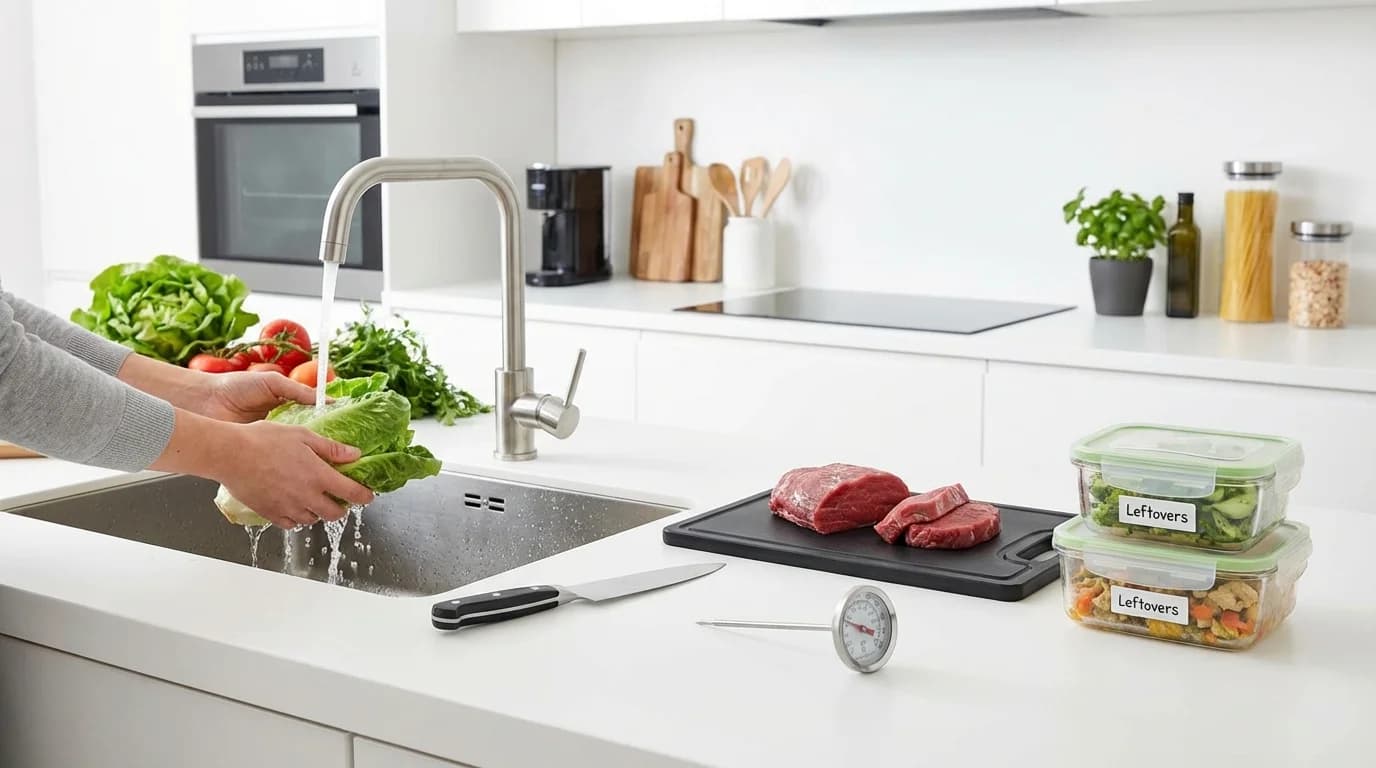
Food Safety Basics for the Kitchen: Essential Guidelines to Prevent Illness
Food safety isn't glamorous, but it's absolutely critical. Foodborne illness affects millions annually, yet most cases are preventable with proper handling, cooking, and storage practices. Whether you're meal prepping for the week, cooking for your family, or learning basic techniques, understanding food safety protects you and those you feed. This comprehensive guide covers the essential principles every home cook needs to know.
The Four Pillars of Food Safety
The USDA and FDA identify four fundamental practices:
1. Clean (Prevent Contamination)
Wash hands:
- Before, during, and after food prep
- After touching raw meat, poultry, seafood, or eggs
- After using the bathroom, touching pets, or coughing/sneezing
- For 20 seconds with soap and warm water
Wash surfaces and utensils:
- Cutting boards after each use, especially after raw meat
- Knives and utensils between tasks
- Countertops before and after food prep
- Can tops before opening
Don't wash:
- Raw chicken, meat, or turkey (spreads bacteria via splashing)
- Eggs (the protective coating keeps bacteria out)
2. Separate (Avoid Cross-Contamination)
Use separate cutting boards:
- One for raw meat, poultry, seafood
- One for produce, bread, and ready-to-eat foods
- Color-coded boards make this easier
Keep raw and cooked food separate:
- In the shopping cart
- In the refrigerator
- During preparation
- Never reuse plates that held raw meat without washing
Separate in the fridge:
- Store raw meat on the bottom shelf (prevents drips onto other food)
- Keep ready-to-eat foods on upper shelves
3. Cook (Destroy Harmful Bacteria)
Use a food thermometer (the only reliable way to know food is safe):
- Poultry (all): 165°F
- Ground meats: 160°F
- Beef, pork, lamb (steaks/chops/roasts): 145°F with 3-minute rest
- Fish and shellfish: 145°F
- Eggs: 160°F (or until yolk and white are firm)
- Leftovers and casseroles: 165°F
Microwave safety:
- Cover food to create steam
- Rotate for even heating
- Let stand after cooking (continues heating)
- Stir and check temperature in multiple spots
Understanding the "Danger Zone":
- 40-140°F is where bacteria multiply rapidly
- Food left in this range for 2+ hours is unsafe
- (1 hour if ambient temperature is above 90°F)
4. Chill (Slow Bacterial Growth)
Refrigerate promptly:
- Within 2 hours of cooking (1 hour if above 90°F outside)
- Keep refrigerator at 40°F or below
- Keep freezer at 0°F or below
Proper cooling techniques:
- Divide large portions into smaller containers
- Use shallow containers (no more than 2-3 inches deep)
- Don't overcrowd the refrigerator (needs air circulation)
- Uncovered initially is okay—speeds cooling
- Cover once cooled to room temperature
Never thaw at room temperature:
- Use refrigerator (slowest but safest)
- Use cold water (change every 30 minutes)
- Use microwave (cook immediately after)
Safe Minimum Cooking Temperatures
Use an instant-read thermometer inserted into the thickest part (avoid bone):
Poultry
All poultry (chicken, turkey, duck): 165°F
- Whole bird: Check thigh and breast
- Ground poultry: 165°F
- Stuffing (inside or outside bird): 165°F
No exceptions on this temperature—salmonella risk is too high.
Ground Meats
Beef, pork, lamb: 160°F
- Burgers, meatballs, meatloaf
- Ground meat has more surface area exposed to bacteria
Beef, Pork, Lamb (Whole Cuts)
Steaks, chops, roasts: 145°F + 3-minute rest
- Rest time allows temperature to remain constant or rise, destroying pathogens
- USDA updated pork guidance—145°F is safe (slightly pink is fine)
Fish and Seafood
All fish and shellfish: 145°F
- Flesh should be opaque and separate easily with a fork
- Shrimp, lobster, crab: flesh pearly and opaque
- Clams, mussels, oysters: shells open during cooking (discard any that don't open)
Note: Many chefs prefer fish at 125-130°F for quality, accepting minimal increased risk. This is a personal choice.
Eggs
Eggs: 160°F (or until yolk and white are firm)
- Scrambled eggs: Cook until no visible liquid egg
- Fried eggs: Cook until yolk begins to thicken
- Casseroles with eggs: 160°F internal temperature
Raw eggs: Pregnant women, young children, elderly, and immunocompromised should avoid raw/undercooked eggs (cookie dough, homemade mayo, soft-cooked eggs).
Food Storage Guidelines
Refrigerator Storage (40°F or below)
How long foods keep (refrigerated):
Raw meat, poultry, seafood:
- Ground meat, stew meat: 1-2 days
- Steaks, chops, roasts: 3-5 days
- Chicken/turkey (whole): 1-2 days
- Chicken/turkey (pieces): 1-2 days
- Fish: 1-2 days
Cooked food:
- Cooked meat, poultry: 3-4 days
- Cooked fish: 3-4 days
- Soup or stew: 3-4 days
- Pizza: 3-4 days
- Leftovers (general): 3-4 days
Eggs:
- Fresh eggs (in shell): 3-5 weeks
- Hard-boiled eggs: 1 week
- Egg salad: 3-4 days
Dairy:
- Milk: 7 days after opening (check date)
- Yogurt: 7-14 days (check date)
- Hard cheese: 3-4 weeks after opening
- Soft cheese: 1 week
Produce:
- Varies widely—check for spoilage signs
- Most prepared/cut produce: 3-5 days
When in doubt, throw it out. Spoilage isn't always visible or aromatic.
Freezer Storage (0°F or below)
How long foods maintain quality (frozen at 0°F):
Meat:
- Ground meat: 3-4 months
- Steaks, chops: 4-12 months
- Roasts: 4-12 months
Poultry:
- Whole chicken/turkey: 1 year
- Chicken pieces: 9 months
Fish and seafood:
- Fatty fish (salmon): 2-3 months
- Lean fish: 6 months
- Shellfish: 3-6 months
Prepared foods:
- Soups, stews: 2-3 months
- Casseroles: 2-3 months
- Cooked meat dishes: 2-3 months
Breads, baked goods:
- Bread: 3 months
- Cookies: 3 months
- Cake: 4-6 months
Note: These times are for quality, not safety. Food kept constantly frozen at 0°F remains safe indefinitely, but quality degrades over time.
Cross-Contamination Prevention
Cross-contamination occurs when bacteria transfer from one food (usually raw animal products) to another.
High-Risk Scenarios:
Cutting board contamination:
- Using the same board for raw chicken and salad vegetables
- Solution: Dedicated boards or wash thoroughly with hot soapy water between uses
Knife contamination:
- Cutting raw meat, then vegetables without washing knife
- Solution: Wash knife (and hands) between tasks
Plate contamination:
- Returning cooked meat to the plate that held raw meat
- Solution: Use a clean plate for cooked food
Refrigerator contamination:
- Raw meat dripping onto produce below
- Solution: Always store raw meat on bottom shelf in containers that catch drips
Marinade contamination:
- Reusing marinade that touched raw meat as a sauce
- Solution: Reserve clean marinade before adding meat, or boil used marinade for 5 minutes
Learn more about proper marinating techniques.
The Two-Board System
Board 1 (often red): Raw meat, poultry, seafood only Board 2 (often green): Produce, bread, ready-to-eat foods
This simple system dramatically reduces cross-contamination risk.
Thawing Food Safely
Never thaw at room temperature (allows bacteria to multiply on outer layers while center remains frozen).
Safe Thawing Methods:
Refrigerator thawing (safest):
- Place on a plate or in a container to catch drips
- Allow 24 hours for every 5 pounds
- Once thawed, cook within 1-2 days
- Can refreeze without cooking (though quality may decline)
Cold water thawing (faster):
- Place food in leak-proof plastic bag
- Submerge in cold water
- Change water every 30 minutes
- Cook immediately after thawing
- Don't refreeze without cooking first
Microwave thawing (fastest):
- Use defrost setting
- Cook immediately after thawing
- Some areas may start cooking during defrosting
- Don't refreeze without cooking first
Cooking from frozen (no thawing needed):
- Adds approximately 50% to cooking time
- Works well for many items (thin cuts, ground meat, vegetables)
- Use a thermometer to ensure proper internal temperature
Leftover Safety
Storing Leftovers:
- Cool quickly: Divide large amounts into shallow containers
- Refrigerate within 2 hours of cooking (1 hour if above 90°F)
- Label with date: Easy to track how long it's been stored
- Use within 3-4 days: Or freeze for longer storage
Reheating Leftovers:
Stovetop: Heat until steaming hot, stirring occasionally Oven: Cover to retain moisture, heat to 165°F internal temperature Microwave: Cover, stir halfway through, heat to 165°F, let stand 2 minutes
Important: Only reheat the portion you'll eat. Repeated heating/cooling increases bacteria risk.
Safe reheating rule: Bring all leftovers to 165°F before eating.
How Many Times Can You Reheat?
Safest practice: Once Maximum: Twice, if handled properly Best approach: Only reheat the amount you'll consume
Meal Prep Food Safety
Meal prep requires extra attention to food safety:
Safe Meal Prep Practices:
Prep time:
- Work with clean hands, surfaces, and utensils
- Complete prep within 2 hours total
- Keep prepped ingredients refrigerated until assembly
Cooling:
- Cool cooked food completely before portioning
- Use shallow containers
- Don't stack containers until food is cool
Storage:
- Use airtight containers
- Label with prep date
- Store earliest meals in front for easy access
Timing:
- Prepare Sunday for Monday-Thursday meals
- Prepare Wednesday for Friday-Sunday meals
- Don't prep more than 4 days ahead
Freezing:
- Freeze meals for beyond 4 days
- Thaw in refrigerator overnight before consuming
- Reheat to 165°F
Signs of Spoilage
When to discard food:
Appearance:
- Mold (even if only on one part—discard the entire item except hard cheese)
- Slimy texture on meat
- Change in color (gray meat, brown lettuce)
Smell:
- Off, sour, or unusual odors
- Trust your nose—if it smells wrong, it is wrong
Texture:
- Slimy or sticky when it shouldn't be
- Excessively soft fruits/vegetables
Packaging:
- Bulging cans (sign of gas from bacteria)
- Damaged or compromised packaging
Time:
- Beyond storage guidelines even if it looks/smells fine
Critical rule: "When in doubt, throw it out." Food poisoning isn't worth the risk.
High-Risk Foods (Handle with Extra Care)
Raw or undercooked meat, poultry, seafood, and eggs
- Greatest risk for salmonella, E. coli, and other pathogens
Unpasteurized dairy and juices
- Can contain harmful bacteria
Raw sprouts
- Difficult to wash bacteria from sprouting environment
Soft cheeses (if unpasteurized)
- Brie, feta, blue cheese, queso fresco
- Check label for pasteurization
Deli meats and hot dogs (if not reheated)
- Can harbor listeria even when refrigerated
High-risk populations (pregnant women, young children, elderly, immunocompromised) should be especially careful with these foods.
Cutting Board Hygiene
Immediate cleaning:
- Wash with hot, soapy water after each use
- Scrub with brush to get into grooves
Sanitizing:
- Weekly: Sanitize with diluted bleach solution (1 tablespoon bleach per gallon water)
- Let sit 2 minutes, rinse thoroughly
- Or run through dishwasher if dishwasher-safe
Replacement:
- Replace cutting boards with deep grooves (bacteria harbor there)
- Especially boards used for raw meat
Material considerations:
- Plastic: Dishwasher-safe, easy to sanitize, affordable
- Wood: Naturally antibacterial, gentler on knives, requires more care
- Both are safe if properly maintained
Kitchen Sponge and Dishcloth Safety
Sponges and dishcloths are bacteria magnets:
Sponges:
- Microwave damp sponge for 1 minute daily (kills most bacteria)
- Run through dishwasher regularly
- Replace every 2 weeks
Dishcloths:
- Wash in hot water daily
- Use separate cloths for different tasks (dishes vs. counters)
- Replace or sanitize weekly
Better option: Use paper towels for cleaning up after raw meat.
What to Do If You Think You Have Food Poisoning
Symptoms (appear 6 hours to 6 days after eating contaminated food):
- Nausea, vomiting, diarrhea
- Abdominal cramps
- Fever
Treatment (for mild cases):
- Stay hydrated (water, clear broths, electrolyte drinks)
- Rest
- Avoid solid food until symptoms subside
- Gradually reintroduce bland foods
Seek medical attention if:
- Symptoms are severe or prolonged (3+ days)
- High fever (over 101.5°F)
- Blood in stool
- Signs of dehydration
- High-risk individual (pregnant, very young/old, immunocompromised)
Conclusion
Food safety isn't complicated, but it requires consistent habits. Clean, separate, cook, and chill—these four principles prevent the vast majority of foodborne illness. Use a food thermometer, refrigerate promptly, prevent cross-contamination, and trust your instincts when food seems questionable.
These practices become second nature with repetition. Start by implementing one or two changes (like using a thermometer or separating cutting boards), then build from there. The small effort required for food safety pays enormous dividends in protecting your health and that of everyone you feed.
Whether you're preparing quick weeknight meals, meal prepping for the week, or slow cooking for Sunday dinner, these food safety basics ensure your cooking is not only delicious but also safe.
About myrecipe
myrecipe helps families save, organize, and share their favorite recipes in one place. Plan meals, create shopping lists, and preserve your culinary traditions.
Start Organizing Recipes