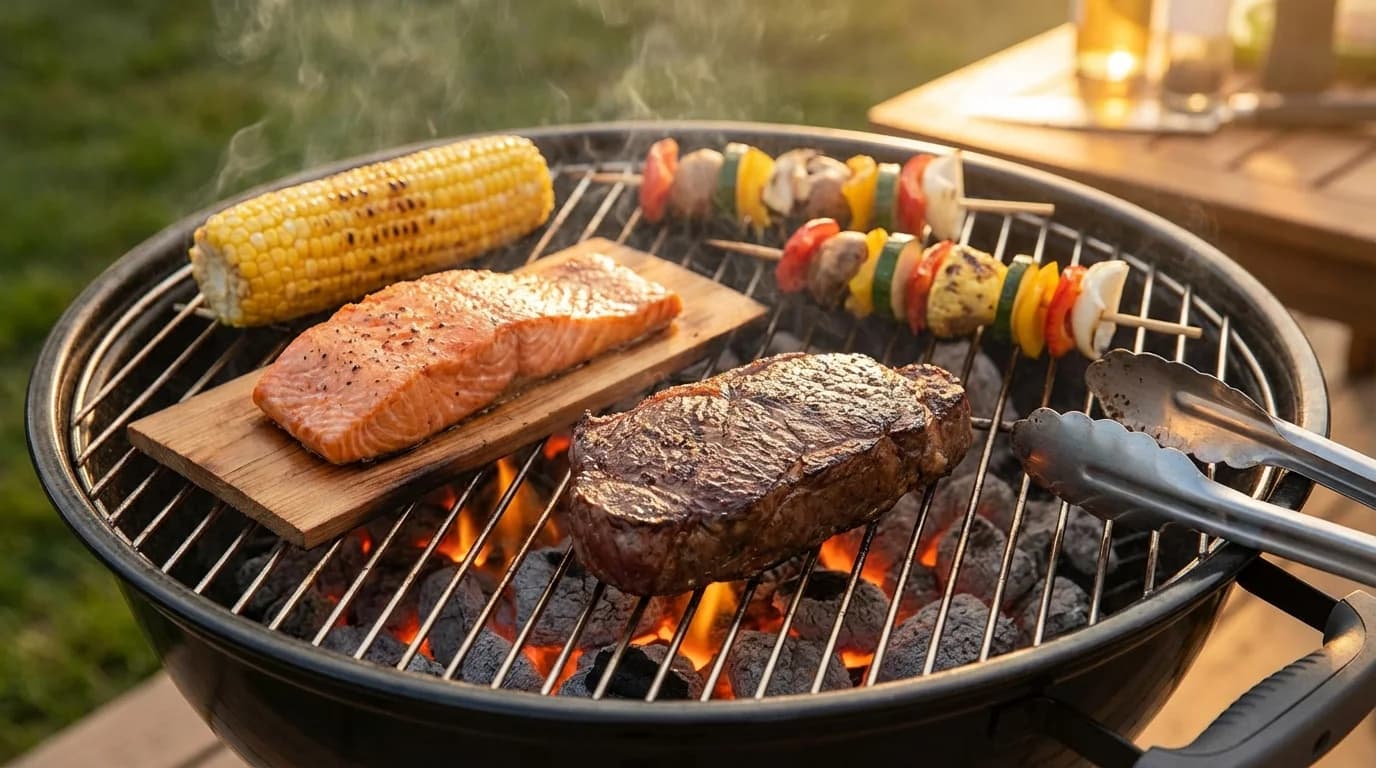
Grilling Temperatures Guide: Perfect Heat for Every Food
Grilling is about more than just fire and food—it's about control. The difference between perfectly charred steak and incinerated hockey pucks comes down to understanding heat zones, managing temperature, and knowing when to use direct versus indirect heat. This comprehensive guide teaches you everything you need to know about grilling temperatures, from setting up heat zones to perfect doneness for every type of food.
Understanding Grilling Heat Levels
Before diving into specific foods, understand the four heat zones:
High Heat: 450-550°F
Hand test: You can hold your hand 5-6 inches above the grill for only 2-3 seconds
Visual cues: Coals glow bright orange, flames flicker when lid is lifted
Best for:
- Searing steaks
- Thin cuts of meat
- Burgers
- Pizza
- Quick-cooking vegetables (asparagus, peppers)
Purpose: Creates rapid Maillard reaction for crust development
Medium-High Heat: 375-450°F
Hand test: Can hold hand above grill for 4-5 seconds
Visual cues: Coals have ash coating but still glow underneath
Best for:
- Chicken pieces (bone-in)
- Pork chops
- Sausages
- Fish fillets
- Most vegetables
Purpose: Balanced cooking—good browning without burning before interior cooks
Medium Heat: 325-375°F
Hand test: Can hold hand above grill for 6-7 seconds
Visual cues: Coals mostly ash-covered with faint glow
Best for:
- Whole chicken (indirect cooking)
- Turkey breast
- Larger roasts (indirect)
- Delicate fish
- Fruits
Purpose: Gentler cooking for thicker cuts that need time without burning
Low Heat: 225-325°F
Hand test: Can hold hand above grill for 8-10 seconds
Visual cues: Minimal visible glow, mostly ash
Best for:
- Smoking
- Pulled pork
- Brisket
- Ribs
- Low and slow cooking
Purpose: Breaking down connective tissue, developing smoke flavor
Direct vs. Indirect Heat
Understanding these two fundamental approaches is essential:
Direct Heat
What it is: Food cooks directly over the heat source
When to use:
- Quick-cooking foods (burgers, steaks, chops, vegetables)
- When you want char and grill marks
- Foods under 1.5 inches thick
Setup:
- Spread coals evenly across bottom (charcoal)
- Turn all burners to same temperature (gas)
Technique: High heat, short cooking time, frequent flipping
Indirect Heat
What it is: Food cooks beside (not over) the heat source, like an outdoor oven
When to use:
- Large cuts (whole chicken, roasts, whole fish)
- Foods that need long cooking without burning
- Smoking and low-and-slow cooking
- Thick cuts (over 1.5 inches)
Setup:
- Charcoal: Push coals to one or both sides, leaving center empty. Place drip pan in center.
- Gas: Light burners on one side only, or use outer burners and turn off center burner(s)
Technique: Lower heat, longer cooking time, lid stays closed
Two-Zone Cooking (The Best of Both)
Setup: Create both direct and indirect zones on your grill
How:
- Charcoal: Bank all coals on one side
- Gas: High heat on one side, off or low on the other
Why it's ideal: Sear over direct heat, then move to indirect to finish cooking. Provides maximum control.
Example: Sear steaks over high direct heat 2-3 minutes per side, move to indirect to reach desired doneness without burning.
Temperature Guide by Food Type
Beef Steaks (1-1.5 inches thick)
Grill temperature: High (450-550°F), direct heat Internal temp targets:
- Rare: 120-125°F
- Medium-rare: 130-135°F (recommended)
- Medium: 135-145°F
- Medium-well: 145-155°F
- Well-done: 155°F+
Timing (per side):
- Rare: 2-3 minutes
- Medium-rare: 3-4 minutes
- Medium: 4-5 minutes
- Medium-well: 5-6 minutes
Technique:
- Pat steaks dry, season generously
- Sear over high direct heat
- Flip once halfway through
- Check internal temp with instant-read thermometer
- Rest 5-10 minutes before serving
For thick steaks (2+ inches), use reverse-sear: cook over indirect heat until 10-15°F below target, then sear over high direct heat.
Burgers
Grill temperature: Medium-high to high (400-500°F), direct heat Internal temp: 160°F (USDA recommendation for ground beef) Timing: 4-5 minutes per side for medium
Technique:
- Don't press burgers with spatula (releases juices)
- Flip only once
- Add cheese in last minute with lid closed
- Toast buns on cooler part of grill
Chicken Breasts (Boneless, Skinless)
Grill temperature: Medium-high (375-450°F), direct or two-zone Internal temp: 165°F (no exceptions for safety) Timing: 6-8 minutes per side
Technique:
- Pound to even thickness
- Oil and season
- Grill over direct heat, turning once
- Move to indirect if exterior browns before interior reaches 165°F
- Rest 5 minutes
Pro tip: Brine for 30 minutes (1/4 cup salt per quart water) for juicier results.
Chicken Pieces (Bone-in, Skin-on)
Grill temperature: Medium (325-375°F), indirect heat primarily Internal temp: 165°F (breast), 175°F (thighs/drumsticks for best texture) Timing: 35-45 minutes total
Technique:
- Start skin-side up over indirect heat for 30 minutes
- Flip skin-side down over indirect, cook 10 more minutes
- Move skin-side down to direct heat for 2-3 minutes to crisp skin
- Watch for flare-ups from rendering fat
Whole Chicken
Grill temperature: Medium (325-375°F), indirect heat Internal temp: 165°F in breast, 175°F in thigh Timing: 1.25-1.5 hours
Technique:
- Spatchcock (remove backbone) for faster, more even cooking
- Place over drip pan in indirect zone
- Maintain steady temperature
- Crisp skin over direct heat in final 5-10 minutes if desired
Pork Chops (Bone-in)
Grill temperature: Medium-high (375-425°F), two-zone Internal temp: 145°F (USDA updated guidance—slight pink is safe) Timing: 4-5 minutes per side for 1-inch chops
Technique:
- Sear over direct heat 2-3 minutes per side
- Move to indirect to finish
- Don't overcook—145°F is perfectly safe and much juicier than 160°F
Pork Tenderloin
Grill temperature: Medium-high (400°F), two-zone Internal temp: 145°F Timing: 15-20 minutes total
Technique:
- Sear all sides over direct heat
- Move to indirect heat
- Roll occasionally for even cooking
- Rest 10 minutes—temperature will rise to 150°F
Ribs (Pork Spare Ribs or Baby Back)
Grill temperature: Low (225-275°F), indirect heat Internal temp: 190-205°F (for tender, pull-apart texture) Timing: 3-5 hours (depending on temperature)
Technique:
- Use 3-2-1 method: 3 hours unwrapped, 2 hours wrapped in foil, 1 hour unwrapped with sauce
- Maintain steady temperature
- Add wood chunks for smoke
- Bones should pull away cleanly when done
Pulled Pork (Shoulder/Boston Butt)
Grill temperature: Low (225-250°F), indirect heat Internal temp: 195-205°F (collagen fully breaks down) Timing: 1.5-2 hours per pound (8-12 hours for typical roast)
Technique:
- Rub generously with spices
- Place over drip pan in indirect zone
- Maintain steady temperature (most challenging part)
- Wrap in foil at 165°F to push through "stall"
- Meat should pull apart easily when done
Salmon Fillets
Grill temperature: Medium-high (375-400°F), direct heat Internal temp: 125-130°F (translucent center) or 145°F (USDA recommendation) Timing: 4-6 minutes per side, depending on thickness
Technique:
- Oil the grill grates well
- Start skin-side down (if skin-on)
- Don't flip until it releases naturally (4-6 minutes)
- Flip once, cook until desired doneness
- Use a fish spatula for support
Pro tip: Place fillets on a cedar plank for easier handling and smoke flavor.
Fish (Firm White Fish: Halibut, Swordfish, Mahi)
Grill temperature: Medium-high (375-425°F), direct heat Internal temp: 130-135°F Timing: 3-4 minutes per side for 1-inch fillets
Technique:
- Pat dry, brush with oil
- Clean and oil grates thoroughly
- Place presentation-side down first
- Don't move until it releases
- Flip gently once
Delicate Fish (Flounder, Tilapia, Trout)
Grill temperature: Medium (325-375°F), direct heat Timing: 2-3 minutes per side
Technique:
- Use a fish basket or grill mat
- Or leave skin on and don't flip—cook skin-side down only
- Very delicate—handle carefully
Shrimp
Grill temperature: High (450-500°F), direct heat Internal temp: 120°F (opaque, pink, slightly firm) Timing: 2-3 minutes per side
Technique:
- Thread on skewers (prevents falling through grates)
- Oil and season
- Cook over high heat quickly
- Remove when pink and opaque
Vegetables
Hardy vegetables (onions, peppers, zucchini, asparagus):
- Temperature: Medium-high (400-450°F)
- Timing: 6-10 minutes, turning occasionally
- Technique: Oil, season, grill over direct heat until tender with char marks
Root vegetables (potatoes, carrots, beets):
- Temperature: Medium (350-400°F), indirect heat
- Timing: 30-45 minutes
- Technique: Wrap in foil with oil and seasonings, cook until tender
Corn on the cob:
- Temperature: Medium-high (400-450°F)
- Timing: 12-15 minutes
- Technique: Husk on over direct heat, turning every 3-4 minutes; or shucked and oiled over direct heat
Learn more detailed vegetable techniques in our roasting vegetables guide.
Pizza
Grill temperature: High (500-550°F), direct heat Timing: 8-12 minutes total
Technique:
- Preheat grill and pizza stone if using
- Stretch dough, oil one side
- Place oil-side down over direct heat
- Cook 3-4 minutes until bottom sets
- Flip, add toppings, close lid
- Cook 5-8 minutes until crust is done and cheese melts
Managing Grill Temperature
Charcoal Grills
To increase temperature:
- Open vents wider (more oxygen = hotter fire)
- Add more charcoal
- Stir coals to remove ash
- Remove lid
To decrease temperature:
- Close vents partially
- Spread coals out more
- Add water pan to absorb heat
- Close lid
Maintaining steady temperature:
- Check every 30 minutes
- Adjust vents gradually (small changes have big effects)
- Add 5-10 briquettes every hour for long cooks
Gas Grills
Temperature control is easier:
- Adjust burner knobs
- Use built-in thermometer
- Preheat 10-15 minutes before cooking
Two-zone setup:
- High on one side, off or low on the other
- Provides flexibility for searing and finishing
Using a Thermometer
Instant-read thermometer (essential tool):
- Insert into thickest part of meat
- Avoid touching bone (reads hotter than meat)
- Remove food 5°F before target (carryover cooking)
Grill thermometer:
- Lid thermometer reads higher than grate level
- For accuracy, place an oven thermometer on the grate
Wireless/Bluetooth thermometers:
- Leave in meat while cooking
- Alert when target temperature is reached
- Invaluable for long cooks
Flare-Ups and How to Handle Them
Causes: Fat dripping onto hot coals or burners
Prevention:
- Trim excess fat from meat
- Use indirect heat for fatty cuts
- Keep lid closed when possible
- Have a spray bottle of water nearby
Response:
- Move food to indirect zone temporarily
- Close lid to starve flames of oxygen
- Never spray water on gas grill (can damage)
- Don't use water on grease fires—it spreads them
Food Safety on the Grill
Minimum safe internal temperatures (USDA):
- Poultry (all): 165°F
- Ground meats: 160°F
- Pork: 145°F (with 3-minute rest)
- Beef, lamb (steaks/chops): 145°F (with 3-minute rest)
- Fish: 145°F (most chefs prefer 125-130°F for quality)
Cross-contamination prevention:
- Use separate plates for raw and cooked food
- Don't reuse marinade that touched raw meat (or boil it first)
- Clean grill grates between different proteins
See our food safety basics guide for comprehensive information.
Conclusion
Mastering grilling temperatures transforms you from someone who "cooks on the grill" to someone who truly grills well. Understanding heat zones, knowing when to use direct versus indirect heat, and managing temperature throughout the cook are the foundations of excellent grilling.
Start with simple direct-heat cooking (burgers, steaks, vegetables) to build confidence. As you become comfortable managing temperature, progress to two-zone cooking and then long, low-and-slow cooks. Invest in a good instant-read thermometer—it's the difference between guessing and knowing.
Whether you're grilling quick weeknight dinners or elaborate weekend barbecues, these temperature guidelines ensure perfectly cooked food every time. With practice, you'll develop intuition for heat management, making grilling feel effortless and producing consistently delicious results.
About myrecipe
myrecipe helps families save, organize, and share their favorite recipes in one place. Plan meals, create shopping lists, and preserve your culinary traditions.
Start Organizing Recipes