Pan Searing Techniques: Master Perfect Crust Every Time
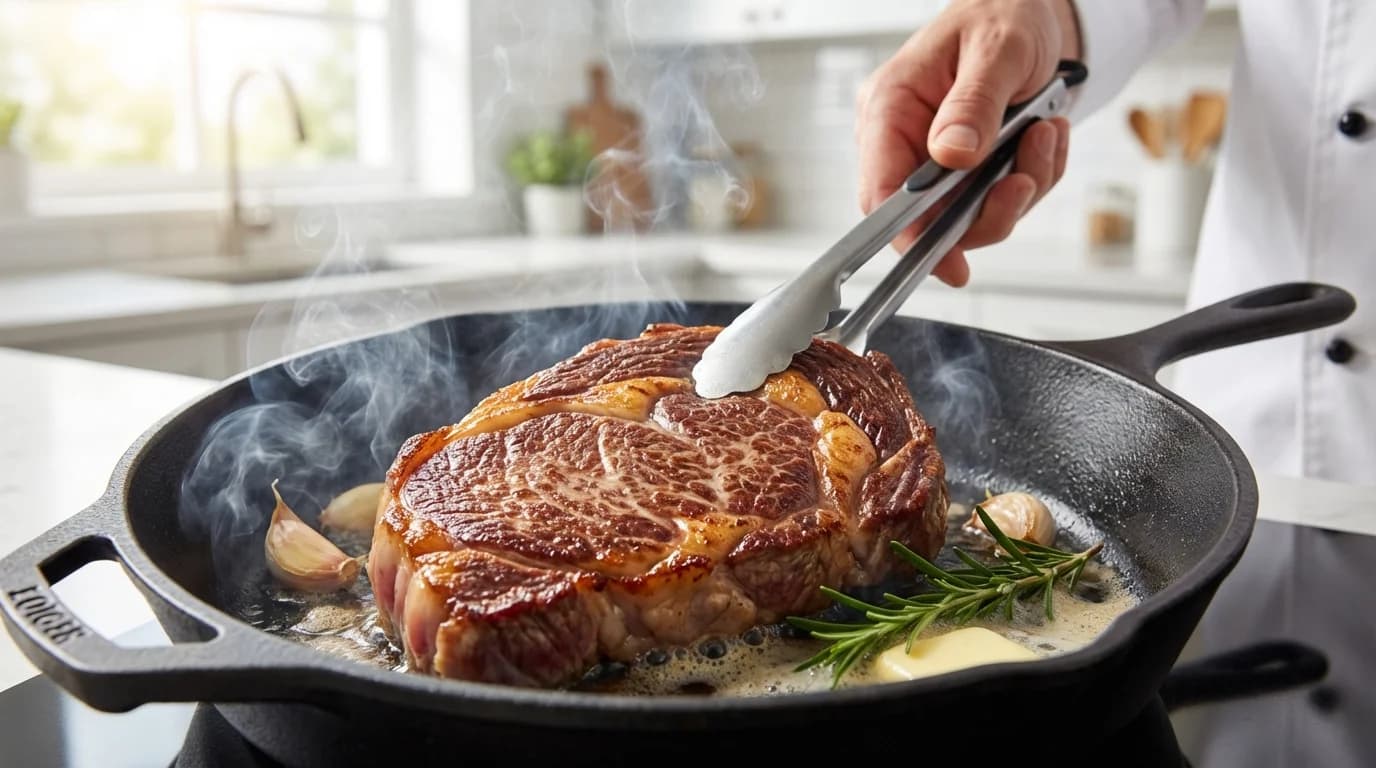
Pan searing is the foundation of countless restaurant dishes—from perfectly crusted steaks to golden-brown fish fillets to caramelized scallops. This high-heat cooking method creates the rich, complex flavors of the Maillard reaction while keeping interiors juicy and tender. Yet many home cooks struggle with sticking, uneven browning, or overcooked exteriors with raw centers. This comprehensive guide teaches you the techniques professional chefs use to achieve flawless sears every single time.
What is Pan Searing?
Searing is cooking food over high heat to develop a deeply browned, flavorful crust. The process involves:
High heat (400°F+ pan surface temperature) Minimal movement (food stays stationary to develop crust) Proper timing (enough time to brown without overcooking) Fat medium (oil or butter for heat transfer and flavor)
The goal is creating maximum surface caramelization while preserving moisture and tenderness inside.
The Science: Why Searing Works
The Maillard Reaction
When proteins and sugars are exposed to high heat (above 300°F), they undergo chemical changes that create:
- Hundreds of new flavor compounds
- Rich brown color
- Complex, savory taste
- Appealing aroma
This reaction only occurs on dry surfaces at high temperatures—moisture prevents browning, which is why patting food dry is crucial.
The Myth: "Searing Seals in Juices"
This is false. Searing doesn't create an impermeable barrier. Juices are retained by:
- Not overcooking (use a thermometer)
- Resting meat after cooking (allows juices to redistribute)
- Proper heat management (high enough to brown, not so high it burns)
Searing's value is flavor, not moisture retention.
Essential Equipment
The Pan
Best choice: Heavy stainless steel skillet or cast iron pan
- Retains heat excellently
- Can handle high temperatures
- Creates best crust
- Oven-safe for finishing thick cuts
Good alternative: Carbon steel
- Similar to cast iron but lighter
- Requires seasoning
- Excellent heat retention
Avoid: Non-stick pans
- Can't handle high temperatures safely
- Don't create good fond (browned bits)
- Coating can be damaged by high heat
Size: Use a pan large enough that food has 1-2 inches of space around it. Overcrowding drops temperature and causes steaming instead of searing.
Other Tools
Tongs: For flipping without piercing meat (releasing juices) Instant-read thermometer: Essential for perfect doneness Splatter screen: Reduces mess from splattering oil Ventilation: Searing creates smoke—use your exhaust fan
Best Foods for Pan Searing
Proteins:
- Steaks: Ribeye, strip, filet, flank, skirt
- Pork chops: Bone-in or boneless, 1+ inch thick
- Fish: Salmon, tuna, halibut, sea bass (firm, thick fillets)
- Scallops: Large sea scallops
- Chicken breasts: Boneless, skinless, pounded to even thickness
- Duck breast: Skin-on
- Lamb chops: Loin or rib chops
Characteristics of sear-friendly foods:
- Relatively flat surfaces
- Uniform thickness (or pounded to even thickness)
- Naturally low moisture or can be dried
- Dense enough to hold up to high heat
The Perfect Searing Technique: Step-by-Step
Step 1: Prep the Protein
Remove from refrigerator 30-60 minutes before cooking:
- Room temperature food sears better
- Cooks more evenly
- Cold centers are harder to cook without overcooking exteriors
Pat completely dry:
- Use paper towels to absorb all surface moisture
- Dry food = good sear; wet food = steaming and gray color
- This is the single most important step
Season generously:
- Salt and pepper both sides
- For steaks, use more salt than you think—some falls off
- Season just before searing or 45+ minutes ahead (see dry-brining below)
Step 2: Heat the Pan
- Place empty pan over medium-high to high heat
- Let preheat for 3-5 minutes (longer for cast iron)
- Pan is ready when water droplets immediately sizzle and evaporate
Temperature test:
- Hold your hand 6 inches above the pan—should feel intensely hot
- Or use an infrared thermometer—target 400-450°F
- If it's smoking before oil is added, it's too hot
Step 3: Add Oil
- Add high-smoke-point oil: canola, vegetable, grapeseed, or avocado oil
- Swirl to coat the bottom
- Wait until oil shimmers and slightly smokes
- You need just enough to coat the pan—about 1-2 tablespoons
Oil smoke points:
- Avocado oil: 520°F (best for high-heat searing)
- Grapeseed oil: 420°F
- Canola/vegetable oil: 400°F
- Butter: 350°F (too low for proper searing alone)
- Olive oil: 375-405°F (extra virgin is lower)
For butter flavor, add it at the end of searing or use clarified butter (ghee).
Step 4: Add the Protein
Critical technique:
- Lay food away from you (prevents oil splatter toward you)
- Place it gently but decisively
- It should sizzle immediately and loudly—if not, pan isn't hot enough
- Don't move it
Spacing:
- Leave 1-2 inches between pieces
- If it doesn't fit with space, cook in batches
Step 5: Leave It Alone
This is the hardest part for beginners:
- Do not touch, move, or flip the food
- Searing time: 3-5 minutes depending on thickness
- The crust releases naturally when it's ready
How to tell it's ready to flip:
- Edges start to look opaque (for proteins)
- You can slide a spatula under without resistance
- When you peek underneath (lift a corner), it's deeply golden brown
If it sticks: It's not ready yet. Wait another 30-60 seconds.
Step 6: Flip
- Use tongs or a fish spatula (thin, flexible spatula)
- Flip confidently in one motion
- Listen for that loud sizzle when the second side hits the pan
- Sear the second side for 3-5 minutes
For thick cuts (1.5+ inches):
- After flipping, reduce heat to medium
- Or transfer to a 400°F oven to finish cooking through
- Or add butter and baste (see advanced techniques)
Step 7: Check Doneness
Use an instant-read thermometer inserted into the thickest part:
Beef/Lamb:
- Rare: 120-125°F
- Medium-rare: 130-135°F
- Medium: 135-145°F
- Medium-well: 145-155°F
- Well-done: 155°F+
Pork:
- 145°F (USDA recommendation; slightly pink is safe and juicy)
Chicken:
- 165°F (no lower for food safety)
Fish:
- 125-130°F for most fish
- 145°F (USDA recommendation, but most chefs prefer lower)
Scallops:
- 115-120°F (translucent center)
Remove from heat 5°F before target temperature—carryover cooking will bring it to temp during resting.
Step 8: Rest
- Transfer protein to a plate or cutting board
- Tent loosely with foil (don't wrap tightly—traps steam and softens crust)
- Rest for 5-10 minutes depending on size
- During resting, juices redistribute, ensuring moist, evenly cooked results
While resting, make a pan sauce:
- Pour off excess fat
- Add wine, stock, or other liquid
- Scrape up browned bits (fond)
- Reduce and finish with butter or cream
- Learn more in our how to thicken sauces guide
Advanced Searing Techniques
The Butter Baste
For extra richness and faster cooking:
- Sear first side normally
- Flip the protein
- Add 2-3 tablespoons butter, fresh thyme, crushed garlic
- Tilt pan slightly
- Use a spoon to continuously scoop melted butter over the top
- Baste for 2-3 minutes
This speeds up cooking of the top surface and adds incredible flavor.
Reverse Sear (For Thick Steaks)
- Season steak
- Cook in a 250°F oven until internal temp reaches 115-120°F (30-45 min)
- Remove and pat dry
- Sear in a screaming hot pan for 60-90 seconds per side
Result: Perfect edge-to-edge doneness with excellent crust.
Dry Brining
For the ultimate crust on steaks:
- Season steaks with salt 45 minutes to 24 hours ahead
- Leave uncovered in refrigerator
- Salt draws out moisture, which dissolves the salt, then is reabsorbed
- Surface becomes incredibly dry
- Sear as normal
Creates the best possible crust.
Two-Pan Method
For delicate fish that can break:
- Preheat two pans
- Place fish skin-side down in first pan
- After 3-4 minutes, place second hot pan on top as weight
- Flip both pans together
- Remove top pan
Ensures even cooking and prevents sticking.
Searing Different Proteins
Steak
- Pat dry thoroughly
- Use high heat and don't move
- Flip only once
- Rest 5-10 minutes
- Slice against the grain
See our grilling temperatures guide for outdoor searing.
Fish Fillets
- Pat skin dry (if skin-on)
- Season flesh side generously
- Start skin-side down (or presentation side down for skinless)
- Press gently with spatula for first 30 seconds to prevent curling
- Cook 70-80% of the time on first side
- Flip gently for final 1-2 minutes
Scallops
- Remove side muscle (small tough tag)
- Pat extremely dry (moisture is scallops' enemy)
- Season just before cooking
- Don't touch for 2-3 minutes
- Flip once; cook 1-2 minutes on second side
- Remove while slightly translucent in center
Chicken Breasts
- Pound to even thickness
- Pat dry and season
- Medium-high heat (not as high as steak—chicken needs more time to cook through)
- 6-7 minutes first side, 6-7 minutes second side
- Use thermometer—165°F is done
For easier weeknight meals, try one-pan chicken recipes.
Pork Chops
- Choose chops 1+ inch thick
- Pat dry and season
- Sear 4-5 minutes per side
- Finish in oven if very thick
- Target 145°F internal temperature
Common Searing Mistakes
Mistake 1: Pan Not Hot Enough
Problem: Food sticks, steams instead of sears, looks gray instead of brown
Fix: Preheat pan longer (3-5 minutes minimum). Test with water droplet.
Mistake 2: Overcrowding the Pan
Problem: Temperature drops, food steams, no crust forms
Fix: Cook in batches. Leave space between pieces.
Mistake 3: Not Drying the Food
Problem: Food doesn't brown, creates gray appearance, excess splattering
Fix: Pat thoroughly with paper towels. For ultimate dryness, refrigerate uncovered for hours.
Mistake 4: Moving or Flipping Too Soon
Problem: Food sticks, tears, crust doesn't develop
Fix: Be patient. Wait for the natural release. 3-5 minutes per side minimum.
Mistake 5: Wrong Type of Pan
Problem: Uneven heating, sticking, poor crust
Fix: Use heavy stainless steel or cast iron. Save non-stick for eggs and delicate tasks.
Mistake 6: Not Preheating Long Enough
Problem: Food cooks unevenly, sticks to pan
Fix: Preheat for at least 3-5 minutes. Cast iron needs even longer.
Mistake 7: Adding Food Straight from Fridge
Problem: Exterior overcooks before interior heats through
Fix: Let food come to room temperature for 30-60 minutes.
Mistake 8: Not Resting
Problem: Juices run out when cut, meat is dry
Fix: Always rest protein 5-10 minutes before slicing.
Pan Sauce Basics
After searing, make a quick pan sauce:
- Pour off excess fat (leave 1-2 tablespoons and all the browned bits)
- Add aromatics (shallots, garlic) and sauté 1 minute
- Deglaze with wine, stock, or other liquid (1/2 to 1 cup)
- Scrape browned bits from pan bottom with wooden spoon
- Reduce by half
- Finish with butter, cream, mustard, or herbs
- Season with salt and pepper
- Serve over the protein
This takes 5 minutes and elevates simple seared protein to restaurant quality.
Cleaning Your Pan
After searing:
For stainless steel:
- Let pan cool slightly
- Deglaze with water or make pan sauce
- Scrub with Bar Keeper's Friend if needed
- Dry immediately
For cast iron:
- Wipe out while still warm
- If needed, scrub with coarse salt and oil
- Never use soap if well-seasoned
- Dry completely and apply thin layer of oil
- See our guide on how to season cast iron
Conclusion
Pan searing is one of the most fundamental and valuable cooking techniques you can master. It's simpler than it seems—the keys are high heat, dry surfaces, patience, and proper timing. Once you understand these principles, you'll achieve consistent, restaurant-quality results on everything from weeknight chicken to special-occasion steaks.
Start with easier proteins (chicken, pork chops) to build confidence, then progress to more challenging items (fish, scallops). Pay attention to visual and audio cues—the sizzle when food hits the pan, the browning of edges, the natural release when crust forms. With each successful sear, you'll develop better instincts and more confidence.
Whether you're preparing quick weeknight dinners, meal prep proteins, or special weekend meals, mastering pan-searing techniques ensures your cooking has the deep, complex flavors and appealing presentations that make good food great.
About myrecipe
myrecipe helps families save, organize, and share their favorite recipes in one place. Plan meals, create shopping lists, and preserve your culinary traditions.
Start Organizing Recipes