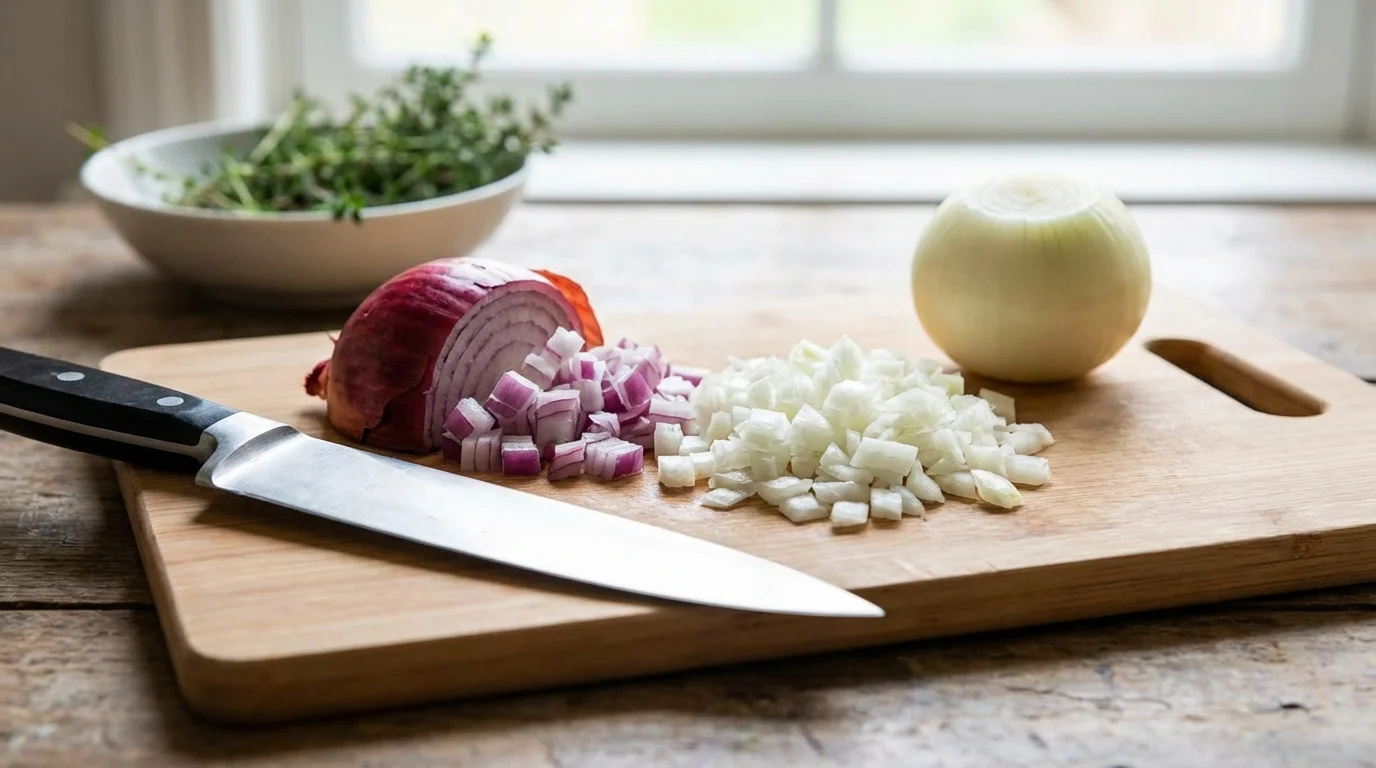
How to Dice Onions Like a Pro: Step-by-Step Guide with Tips
Dicing onions is one of the most fundamental knife skills in cooking. Nearly every cuisine starts with diced onions, making this technique essential for home cooks. Yet many people hack away at onions inefficiently, producing uneven pieces, wasted product, and plenty of tears. This guide teaches you the professional chef's method for dicing onions quickly, uniformly, and safely—transforming a tedious chore into a smooth, confident motion.
Why Proper Onion Dicing Matters
Even cooking: Uniform pieces cook at the same rate, preventing some pieces from burning while others remain raw
Better texture: Consistent dice creates pleasant mouthfeel in finished dishes
Professional appearance: Neat, uniform dice looks more appetizing
Efficiency: The proper technique is faster once mastered
Less waste: Strategic cutting minimizes unusable scraps
Safety: Proper technique keeps fingers away from the blade
Whether you're making soup, stir-fries, or practicing mise en place, mastering this technique elevates your cooking.
Tools You Need
Chef's knife: 8-10 inch knife with a sharp blade. Dull knives require more pressure and are more dangerous. See our knife skills guide for more information.
Cutting board: Stable, large enough for the onion to sit flat. Place a damp towel underneath to prevent slipping.
Optional: Damp paper towel nearby for wiping blade occasionally
The Professional Dicing Method
This technique, used by chefs worldwide, produces perfectly uniform dice in under a minute.
Step 1: Cut the Onion in Half
- Place the onion on your cutting board with the root end (hairy end) to one side, stem end to the other
- Using a sharp chef's knife, cut straight down through the center from stem to root
- You now have two halves with the root intact on each
Why keep the root intact? The root holds the onion layers together during cutting. Removing it too early causes the onion to fall apart.
Step 2: Peel the Onion
- Peel away the papery outer skin
- Remove the first layer if it's tough or damaged
- Leave the root end attached—this is crucial
Tip: Peeling is easier after halving. The cut surface gives you something to grip.
Step 3: Trim the Stem End
- Place one onion half flat-side down on the cutting board
- Trim off just the stem end (the opposite end from the root)
- Make a clean, perpendicular cut
- Leave the root end completely intact
Step 4: Make Horizontal Cuts
This is where the technique becomes distinctly professional:
- Place your free hand flat on top of the onion to stabilize it
- Hold the knife parallel to the cutting board
- Make 2-3 horizontal cuts toward (but not through) the root end
- For small dice (1/4 inch): 3 horizontal cuts
- For medium dice (1/2 inch): 2 horizontal cuts
- For large dice (3/4 inch): 1-2 horizontal cuts
- Keep the cuts parallel to the board
- Stop about 1/2 inch before the root—don't cut through it
Safety note: This step makes beginners nervous. Keep your guiding hand on top of the onion (not in front of the blade) and move slowly and deliberately.
Step 5: Make Vertical Radial Cuts
- Keep the onion flat-side down
- Make vertical cuts perpendicular to the board, following the onion's natural lines (from stem to root)
- Angle your cuts slightly, radiating from the center point of the root
- Space the cuts according to your desired dice size:
- Small dice: 1/4 inch apart
- Medium dice: 1/2 inch apart
- Large dice: 3/4 inch apart
- Cut all the way through but stop before you reach the root
Tip: The natural lines of the onion run from root to stem. Cutting along these lines (rather than against them) is easier and produces cleaner results.
Step 6: Make Crosswise Cuts to Create Dice
This is where the magic happens:
- Turn the onion 90 degrees (or reposition your knife)
- Make cuts perpendicular to your radial cuts
- Space these cuts the same distance apart as your vertical cuts
- The onion will fall into perfect, uniform dice
- When you reach the root end, discard it
Result: Perfectly uniform onion dice in all three dimensions, with minimal waste.
Step 7: Repeat with Second Half
Practice makes perfect. Your second half will go faster than your first.
Dice Size Guide
Different recipes call for different dice sizes:
Fine dice (brunoise): 1/8 inch cubes
- For delicate sauces, fine garnishes
- Cooks very quickly
Small dice: 1/4 inch cubes
- For sautés, most cooked dishes
- The most common all-purpose size
Medium dice: 1/2 inch cubes
- For soups, stews, chunky salsas
- Maintains some texture
Large dice: 3/4 to 1 inch cubes
- For long-simmered dishes, roasting
- When you want onion to be a textural element
Pro tip: Be consistent within a recipe. If you're dicing onions, carrots, and celery for soup, cut them all to the same size so they cook evenly.
Common Mistakes and How to Avoid Them
Mistake 1: Cutting Off the Root Too Soon
Problem: Onion falls apart mid-cutting
Fix: Leave the root completely intact until the very end. It's the "handle" that holds everything together.
Mistake 2: Uneven Cuts
Problem: Some pieces much larger than others
Fix: Maintain consistent spacing on all three sets of cuts. It takes practice—be patient with yourself.
Mistake 3: Using a Dull Knife
Problem: Smashing the onion instead of cutting cleanly, more tears, dangerous slipping
Fix: Sharpen your knife regularly. A sharp knife makes this technique dramatically easier and safer.
Mistake 4: Cutting Against the Grain
Problem: Rough cuts, mushy onion texture
Fix: Cut with the natural lines of the onion (radially) for the vertical cuts, across the grain for the final crosswise cuts.
Mistake 5: Rushing the Horizontal Cuts
Problem: Uneven horizontal cuts or cutting yourself
Fix: This step requires care. Place your guiding hand firmly on top of the onion and move the knife slowly and deliberately.
Mistake 6: Inconsistent Piece Sizes
Problem: Some cook faster than others
Fix: Measure with your eye and maintain the same spacing for all cuts. Consistency comes with repetition.
How to Minimize Tears
Onions release sulfur compounds when cut, which react with eye moisture to create a mild acid—hence the tears.
Effective methods:
Chill the onion: Refrigerate for 30 minutes before cutting. Cold slows the release of tear-inducing compounds.
Use a sharp knife: Clean cuts rupture fewer cells, releasing less of the chemical.
Cut near ventilation: Position yourself near an open window or range hood fan to blow fumes away.
Breathe through your mouth: Reduces the amount of fumes entering your nose and eyes.
Don't cut the root until last: The root contains the highest concentration of sulfur compounds.
Wear contact lenses: If you already wear them, you're in luck—they act as a barrier.
Less effective (but popular) methods:
- Cutting underwater (messy, makes knife work harder)
- Holding bread in your mouth (minimal effect)
- Lighting a candle nearby (questionable effectiveness)
Best approach: Combine a sharp knife, chilled onion, and cutting near ventilation for maximum tear reduction.
Alternative Cutting Methods
The Pole-to-Pole Method
For onion slices (fajitas, burgers):
- Cut onion in half through root and stem
- Peel
- Lay flat side down
- Make cuts from one pole (root) to the other (stem)
- Creates half-moon slices
This method follows the onion's natural grain, so the slices stay more intact during cooking.
The Ring Method
For onion rings:
- Peel whole onion (don't cut in half)
- Cut crosswise into thick slices
- Separate into rings
The Quick Rough Chop
When uniformity doesn't matter:
- Quarter the onion
- Roughly chop each quarter
- Much faster, but uneven pieces
Use this for dishes where onions will be pureed or when texture isn't critical.
What to Do with Onion Scraps
Don't waste them:
-
Stock bag: Save papery skins, root ends, and any usable scraps in a freezer bag for making homemade stock. Onion skins add beautiful golden color.
-
Compost: If you compost, onion scraps are excellent additions.
-
Immediate use: Add root ends and extra layers to stocks, broths, or soups you're making right away.
The papery outer layers and roots shouldn't be eaten but make excellent flavoring for stocks.
Storing Diced Onions
Short-term (same day): Leave diced onions on the cutting board covered with a damp paper towel.
Medium-term (1-2 days): Store in an airtight container in the refrigerator. They'll become stronger in flavor but remain usable.
Long-term (up to 3 months): Freeze diced onions in freezer bags. Spread flat for easier breaking off portions. They'll be softer when thawed but work fine for cooked dishes.
Caution: Pre-diced onions lose flavor and can develop off-tastes. For best results, dice fresh when needed.
Different Onion Types
The dicing technique works for all onions:
Yellow onions: All-purpose, most common. Strong flavor when raw, sweet when cooked.
White onions: Sharper, cleaner flavor. Common in Mexican cuisine.
Red onions: Milder, slightly sweet. Excellent raw in salads or pickled.
Sweet onions (Vidalia, Walla Walla): Mild, high sugar content. Great for caramelizing.
Shallots: Smaller, milder, more delicate. Dice using the same technique but on a smaller scale.
All use the same fundamental dicing method, though sweet onions tend to be juicier and red onions may require an extra layer of skin removed.
Practice Exercises
Week 1: Dice one onion, focusing on keeping the root intact and making clean cuts. Don't worry about speed.
Week 2: Dice two onions, working on consistent spacing between cuts.
Week 3: Dice three onions, aiming to improve your speed while maintaining uniformity.
Week 4: Challenge yourself to dice an onion in under 60 seconds while maintaining good technique.
By the end of a month, you'll have muscle memory and the task will feel natural.
Putting It All Together
Once you master onion dicing, you have the foundation for countless recipes. Onions are the aromatic base for:
- Soups and stews
- Stir-fries
- Sauces and salsas
- One-pot meals
- Slow cooker dishes
- Virtually every cuisine worldwide
This single skill appears in more recipes than almost any other knife technique, making it one of the highest-value skills you can learn.
Conclusion
Dicing onions efficiently and uniformly is a foundational culinary skill that every home cook should master. The professional technique—halve, peel, horizontal cuts, radial cuts, crosswise cuts—produces consistent results quickly and safely. While it feels awkward at first, muscle memory develops rapidly with practice.
Start slowly, focusing on safety and proper technique over speed. Keep your knife sharp, your cutting board stable, and your root end intact. Within a few weeks of regular practice, you'll dice onions with confidence and precision, ready to tackle any recipe that begins with this essential aromatic.
Whether you're building flavors for budget-friendly meals, preparing meal prep ingredients, or cooking elaborate dinners, this technique serves you countless times throughout your cooking journey.
About myrecipe
myrecipe helps families save, organize, and share their favorite recipes in one place. Plan meals, create shopping lists, and preserve your culinary traditions.
Start Organizing Recipes