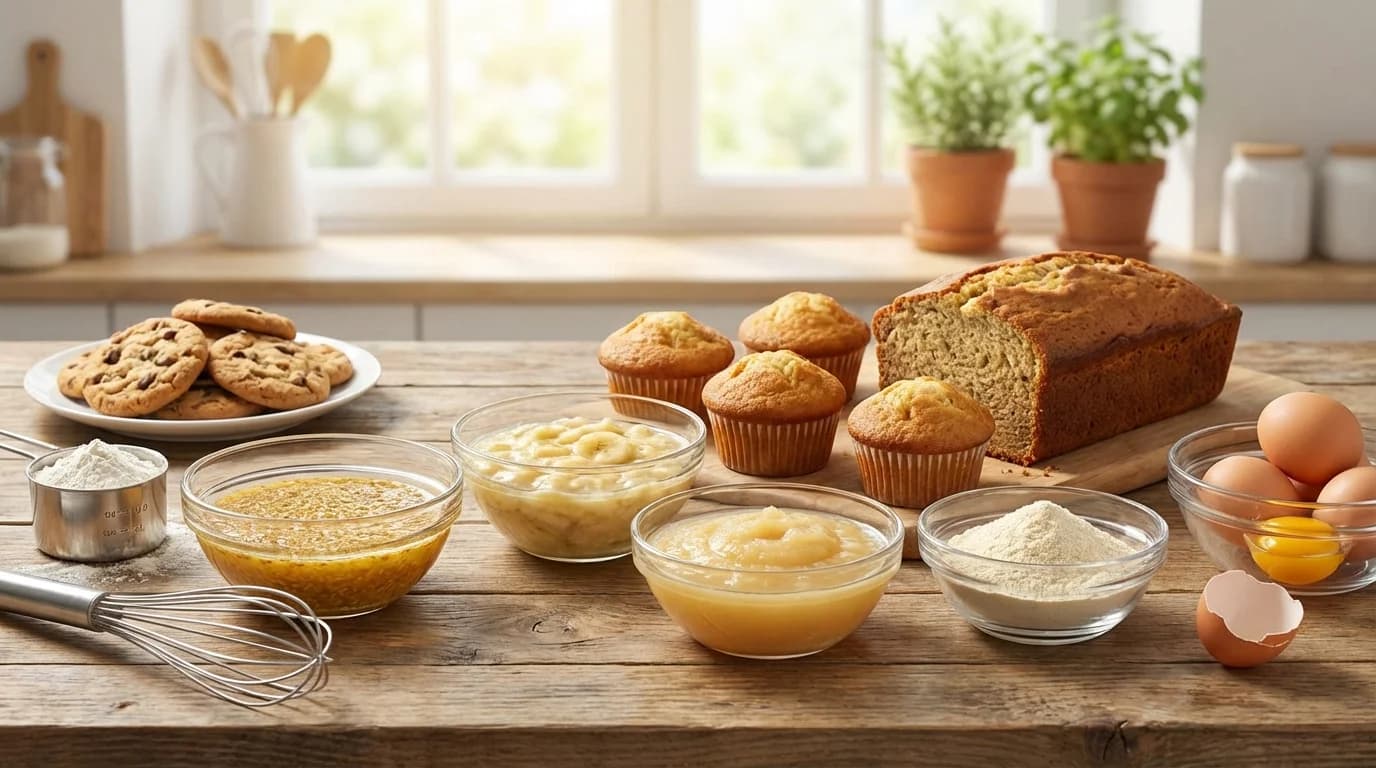
Whether you're baking for someone with an egg allergy, following a vegan diet, or simply ran out of eggs mid-recipe, knowing how to substitute eggs successfully is an essential baking skill. Eggs perform multiple crucial functions in baking—binding, leavening, adding moisture, and creating structure—which makes them challenging to replace. But with the right substitutes and techniques, you can create delicious baked goods that rival their egg-containing counterparts.
Understanding Eggs' Role in Baking
Before substituting, understand what eggs do in your recipe:
Binding
Eggs hold ingredients together, preventing crumbly textures in cookies, muffins, and cakes.
Leavening
Eggs trap air when beaten, helping baked goods rise and creating light, fluffy textures.
Moisture
Eggs add liquid that hydrates dry ingredients and creates tender crumb.
Structure
Egg proteins coagulate when heated, providing structure that helps baked goods hold their shape.
Richness
Eggs contribute flavor, color, and richness to baked goods.
Emulsification
Egg yolks contain lecithin, which helps water and fat mix smoothly.
The Key: Different substitutes excel at different functions. Choose based on what your recipe needs most.
Best Egg Substitutes by Function
For Binding: Flax Eggs
How to Make: Mix 1 tablespoon ground flaxseed + 3 tablespoons water = 1 egg Wait: 5-10 minutes until gelled and thick
Best For: Muffins, pancakes, dense cakes, cookies Texture: Adds slight nuttiness and darker color Nutrition: High in omega-3s and fiber Cost: Affordable Shelf Life: Ground flax lasts 3 months refrigerated
Why It Works: Flax becomes gelatinous when mixed with water, creating binding properties similar to eggs
Tip: Use golden flaxseed for lighter-colored baked goods
For Binding: Chia Eggs
How to Make: Mix 1 tablespoon ground chia seeds + 3 tablespoons water = 1 egg Wait: 10-15 minutes until gelled
Best For: Same as flax eggs—muffins, pancakes, quick breads Texture: Creates slight speckled appearance Nutrition: High in omega-3s, protein, and fiber Cost: Moderate Advantage: Longer shelf life than flax
Similar to Flax: Works on the same principle but takes longer to gel
For Moisture: Applesauce
How to Use: ¼ cup unsweetened applesauce = 1 egg
Best For: Cakes, muffins, brownies, quick breads Texture: Creates moist, dense texture Flavor: Mild apple taste (barely noticeable in spiced recipes) Cost: Very affordable Bonus: Reduces fat in recipes
Perfect For: budget casserole recipes adapted for sweet applications
Downside: Can make baked goods gummy if overused
Pro Tip: Add ¼ teaspoon baking powder per egg replaced to help with leavening
For Moisture and Binding: Mashed Banana
How to Use: ¼ cup mashed ripe banana = 1 egg (about ½ medium banana)
Best For: Pancakes, muffins, quick breads, cakes Texture: Dense and moist Flavor: Distinct banana flavor (use in compatible recipes) Cost: Very affordable Nutrition: Adds potassium and natural sweetness
When to Use: Banana bread, chocolate cake, breakfast items where banana flavor complements
Downside: Strong flavor limits versatility
Adjust Recipe: Reduce sugar slightly as bananas add sweetness
For Leavening: Commercial Egg Replacers
Brands: Bob's Red Mill, Ener-G, Follow Your Heart
How to Use: Follow package directions (usually 1.5 tablespoons powder + 3 tablespoons water = 1 egg)
Best For: Cakes, cookies, light textures Texture: Closest to eggs in most applications Flavor: Neutral Cost: Moderate (but convenient) Ingredients: Usually potato or tapioca starch with leavening agents
Advantage: Specifically formulated for baking, most reliable for beginners
Where to Buy: Natural food stores, well-stocked grocery stores, online
For Richness: Silken Tofu
How to Use: ¼ cup blended silken tofu = 1 egg
Best For: Dense cakes, brownies, quick breads, cheesecakes Texture: Dense and moist Flavor: Completely neutral Cost: Affordable Nutrition: Adds protein
Blend Well: Must be completely smooth with no chunks
Best Application: When you want richness without additional flavor
Try: Works great in cheap healthy meals adapted for desserts
For Moisture: Yogurt or Buttermilk
How to Use: ¼ cup yogurt or buttermilk = 1 egg
Best For: Muffins, cakes, quick breads Texture: Tender and moist Flavor: Slight tang (works well with berries, chocolate) Options: Dairy or non-dairy yogurt both work Cost: Affordable
Vegan Alternative: Use non-dairy yogurt (coconut, soy, almond)
Pro Tip: Add ¼ teaspoon baking soda to activate leavening with the acidity
For Binding and Moisture: Pumpkin Puree
How to Use: ¼ cup pumpkin puree = 1 egg
Best For: Spiced cakes, muffins, quick breads, brownies Texture: Dense and moist Flavor: Mild (works in spiced or chocolate recipes) Seasonal: Perfect for fall baking Cost: Very affordable
Best In: Chocolate recipes, spice cakes, autumn treats
Bonus: Adds vitamin A and fiber
For Richness and Binding: Nut Butter
How to Use: 3 tablespoons nut butter = 1 egg
Best For: Cookies, brownies, dense cakes Texture: Rich, dense, and fudgy Flavor: Adds nut flavor (choose complementary recipes) Options: Almond, peanut, cashew, sunflower seed Cost: Moderate
Perfect For: Peanut butter cookies, chocolate brownies, energy bars
Thin With: 1 tablespoon water if batter seems too thick
For Light Texture: Aquafaba
What It Is: The liquid from canned chickpeas
How to Use: 3 tablespoons aquafaba = 1 egg
Best For: Meringues, macarons, light cakes, mousse Special Ability: Whips into stiff peaks like egg whites! Texture: Creates airy, light textures Flavor: Completely neutral (no bean taste) Cost: Free (byproduct of canned chickpeas)
Revolutionary For: Vegan meringues, marshmallows, and macarons
How to Whip: Beat with electric mixer for 5-10 minutes until stiff peaks form
Storage: Refrigerate up to 5 days or freeze in ice cube trays
Perfect Match: cooking with canned beans—save the liquid!
For Simple Binding: Ground Seeds
How to Use: 1 tablespoon ground pumpkin, sunflower, or hemp seeds + 3 tablespoons water = 1 egg
Best For: Muffins, cookies, quick breads Similar To: Flax and chia eggs Nut-Free: Great for allergy-friendly baking Cost: Affordable
For Commercial Baking: Vinegar and Baking Soda
How to Use: 1 tablespoon vinegar + 1 teaspoon baking soda = 1 egg
Best For: Light, fluffy cakes Texture: Creates lift and tender crumb Flavor: Neutral (acid cooks off) Cost: Very affordable
Why It Works: Acid-base reaction creates carbon dioxide bubbles for leavening
Use In: Vanilla cake, yellow cake, basic cupcakes
Egg Substitute Comparison Chart
| Substitute | Ratio (per 1 egg) | Best For | Primary Function | Flavor Impact |
|---|---|---|---|---|
| Flax Egg | 1 tbsp ground flax + 3 tbsp water | Dense baked goods | Binding | Slight nutty |
| Chia Egg | 1 tbsp ground chia + 3 tbsp water | Dense baked goods | Binding | Minimal |
| Applesauce | ¼ cup unsweetened | Moist cakes, muffins | Moisture | Slight fruity |
| Banana | ¼ cup mashed | Quick breads | Moisture + binding | Strong banana |
| Commercial Replacer | Per package | All-purpose | Multiple | Neutral |
| Silken Tofu | ¼ cup blended | Dense cakes | Richness | Neutral |
| Yogurt | ¼ cup | Tender baked goods | Moisture | Slight tang |
| Pumpkin Puree | ¼ cup | Spiced baked goods | Moisture | Mild earthy |
| Nut Butter | 3 tbsp | Cookies, brownies | Richness + binding | Nutty |
| Aquafaba | 3 tbsp | Light, airy goods | Leavening | Neutral |
| Vinegar + Baking Soda | 1 tbsp + 1 tsp | Light cakes | Leavening | Neutral |
Choosing the Right Substitute for Your Recipe
Cookies
Best Choices: Flax egg, chia egg, nut butter, commercial replacer Why: Need binding more than leavening Texture Goal: Chewy and cohesive
Cakes (Light and Fluffy)
Best Choices: Commercial egg replacer, aquafaba, vinegar + baking soda Why: Need maximum leavening Texture Goal: Airy and tender
Cakes (Dense and Moist)
Best Choices: Applesauce, banana, pumpkin, silken tofu Why: Moisture is priority Texture Goal: Rich and moist
Brownies
Best Choices: Nut butter, applesauce, silken tofu, banana Why: Dense texture is desirable Texture Goal: Fudgy and rich
Muffins and Quick Breads
Best Choices: Flax egg, chia egg, applesauce, yogurt, banana Why: Need binding and moisture Texture Goal: Moist with structure
Pancakes and Waffles
Best Choices: Flax egg, chia egg, banana, yogurt Why: Need binding and slight rise Texture Goal: Fluffy yet cohesive
Meringues and Macarons
Best Choice: Aquafaba Why: Only substitute that whips to stiff peaks Texture Goal: Light and airy
Tips for Successful Egg-Free Baking
Don't Over-Substitute
Rule: Most recipes work well with up to 3 eggs substituted. Beyond that, consider egg-free recipes designed from scratch.
Add Extra Leavening
Tip: Add ¼ teaspoon baking powder per egg substituted to help with rise.
Expect Different Textures
Reality: Egg-free baking often creates denser, more tender textures. This isn't bad—just different!
Let Batters Rest
Why: Many substitutes (especially flax and chia) work better after resting 5-10 minutes.
Don't Overmix
Reason: Without eggs' structure, overmixing can make baked goods tough.
Reduce Oven Temperature Slightly
Tip: Lower temperature by 25°F and bake slightly longer to prevent over-browning.
Test and Adjust
Strategy: Keep notes on what works in your favorite recipes for future reference.
Common Egg-Free Baking Mistakes
Mistake #1: Using Too Many Substitutes
Problem: Replacing 4+ eggs often leads to gummy, dense results Solution: Use recipes designed to be egg-free when you need many eggs
Mistake #2: Not Accounting for Moisture
Problem: Some substitutes add significant moisture (applesauce, banana) Solution: Reduce other liquids slightly or add extra flour
Mistake #3: Wrong Substitute for Recipe Type
Problem: Using banana in delicate vanilla cake Solution: Match substitute to recipe (see chart above)
Mistake #4: Expecting Identical Results
Problem: Disappointment when texture differs from egg version Solution: Appreciate egg-free baking on its own merits
Mistake #5: Not Blending Tofu Thoroughly
Problem: Chunks of tofu in final product Solution: Blend until completely smooth
Budget-Friendly Egg Substitute Strategy
Most Economical Options
- Flaxseed: Lasts months, pennies per "egg"
- Applesauce: Buy in bulk, very affordable
- Banana: Use overripe bananas (often discounted)
- Aquafaba: Free byproduct of canned beans
- Vinegar + Baking Soda: Pantry staples
For Budget Baking: Combine with our budget meal prep beginners approach
When to Splurge
Commercial egg replacers are worth it when:
- You bake egg-free frequently
- You need reliable, neutral results
- Recipe is special occasion/important
Storage and Shelf Life
Ground Flaxseed: 3 months in refrigerator (whole seeds last longer) Chia Seeds: 2 years in cool, dark place Aquafaba: 5 days refrigerated, 3 months frozen Applesauce: Opened jar lasts 10 days refrigerated Commercial Replacers: 1+ year in sealed package
Special Considerations
For Allergies
Egg-Free and Nut-Free: Use flax, chia, applesauce, aquafaba, commercial replacer Egg-Free and Gluten-Free: All substitutes work with GF flours Multiple Allergies: Aquafaba is free of top 8 allergens
For Vegan Baking
Best All-Purpose: Commercial vegan egg replacer or flax eggs For Special Textures: Aquafaba for meringues, nut butter for rich cookies Complete Guide: Pair with cheese substitutes cooking for fully plant-based baking
Recipe Conversion Examples
Chocolate Chip Cookies (calls for 2 eggs)
Replace With: 2 flax eggs OR 6 tablespoons nut butter Adjust: None needed Result: Slightly denser, just as delicious
Vanilla Cake (calls for 3 eggs)
Replace With: Commercial egg replacer per package OR 9 tablespoons aquafaba (whipped) Adjust: Add ½ teaspoon extra baking powder Result: Light and tender
Banana Bread (calls for 2 eggs)
Replace With: ½ cup mashed banana (in addition to bananas in recipe) OR 2 flax eggs Adjust: None needed Result: Extra moist and flavorful
Brownies (calls for 2 eggs)
Replace With: ½ cup silken tofu OR 6 tablespoons nut butter Adjust: Reduce oil by 1 tablespoon Result: Fudgy and rich
The Bottom Line
Egg-free baking is not only possible—it's delicious. The key is understanding what role eggs play in your specific recipe and choosing the substitute that best fulfills that function. Start with simple substitutions in familiar recipes, take notes on what works, and soon you'll have a repertoire of reliable egg-free favorites.
Whether you're baking for dietary restrictions, ethical reasons, or simply because you're out of eggs, these substitutes will help you create treats everyone can enjoy. And remember: egg-free doesn't mean compromise. It means creative, inclusive baking that often costs less and can be just as delicious as traditional recipes.
Ready to start baking? Try these substitutes in your favorite recipes or explore our 5-ingredient recipes for simple baking inspiration that's easy to adapt egg-free!
About myrecipe
myrecipe helps families save, organize, and share their favorite recipes in one place. Plan meals, create shopping lists, and preserve your culinary traditions.
Start Organizing Recipes