Spice Cabinet Organization: A Complete Guide to Finding Your Spices Fast
You're in the middle of cooking dinner when the recipe calls for cumin. You know you have it—somewhere. Five minutes of rummaging through a chaotic spice cabinet later, you find it hidden behind the cinnamon you bought three years ago. Sound familiar?
A disorganized spice collection slows down cooking, leads to duplicate purchases, and lets spices expire before you use them. The average household has $50-100 worth of expired spices taking up valuable kitchen space.
An organized spice system changes everything. You'll cook faster, experiment more confidently, and save money. Best of all, most organization solutions cost under $30 and take just one afternoon to implement.
Why Spice Organization Matters
Time Savings:
- Find spices in seconds, not minutes
- Faster cooking process
- No more recipe interruptions
Money Savings:
- See what you have before buying duplicates
- Use spices before they expire
- Avoid wasting $30-50 annually on expired spices
Cooking Benefits:
- More likely to try new recipes
- Better flavor in dishes (fresh spices)
- Experiment with different cuisines
- Confidence in the kitchen
Space Optimization:
- Spices take minimal space when organized
- Free up cabinet room
- Create functional workspace
The Great Spice Purge
Before organizing, declutter your collection.
Step 1: Remove Everything
Take every spice out of cabinets and drawers. Lay them on counter or table.
Step 2: Check Expiration and Quality
Whole spices: Last 3-4 years Ground spices: Last 2-3 years Dried herbs: Last 1-2 years Seasoning blends: Last 1-2 years
The freshness test:
- Open container
- Smell spice
- If aroma is weak or musty, toss it
- If vibrant smell, keep it
Visual check:
- Faded color = old
- Clumping = moisture exposure (toss)
- Bug activity = toss immediately
Step 3: Eliminate Duplicates
Common duplicates:
- Multiple half-empty containers of garlic powder
- Three containers of Italian seasoning
- Various versions of cinnamon
Consolidate: Combine partials into one container, label with oldest date.
Step 4: Assess Your Collection
Essential spices (most kitchens need):
- Salt (kosher, sea salt)
- Black pepper
- Garlic powder
- Onion powder
- Paprika
- Cumin
- Chili powder
- Cinnamon
- Italian seasoning
- Oregano
- Basil
Specialty spices (keep if you use):
- Curry powder
- Turmeric
- Ginger
- Cardamom
- Coriander
- Nutmeg
- Cloves
- Cayenne
- Red pepper flakes
Discard:
- Expired spices
- Spices you've never used and can't imagine using
- Single-recipe spices from years ago
Realistic assessment: If you haven't used it in a year and don't have plans to, let it go.
Spice Organization Systems
Choose a system based on your kitchen layout and collection size.
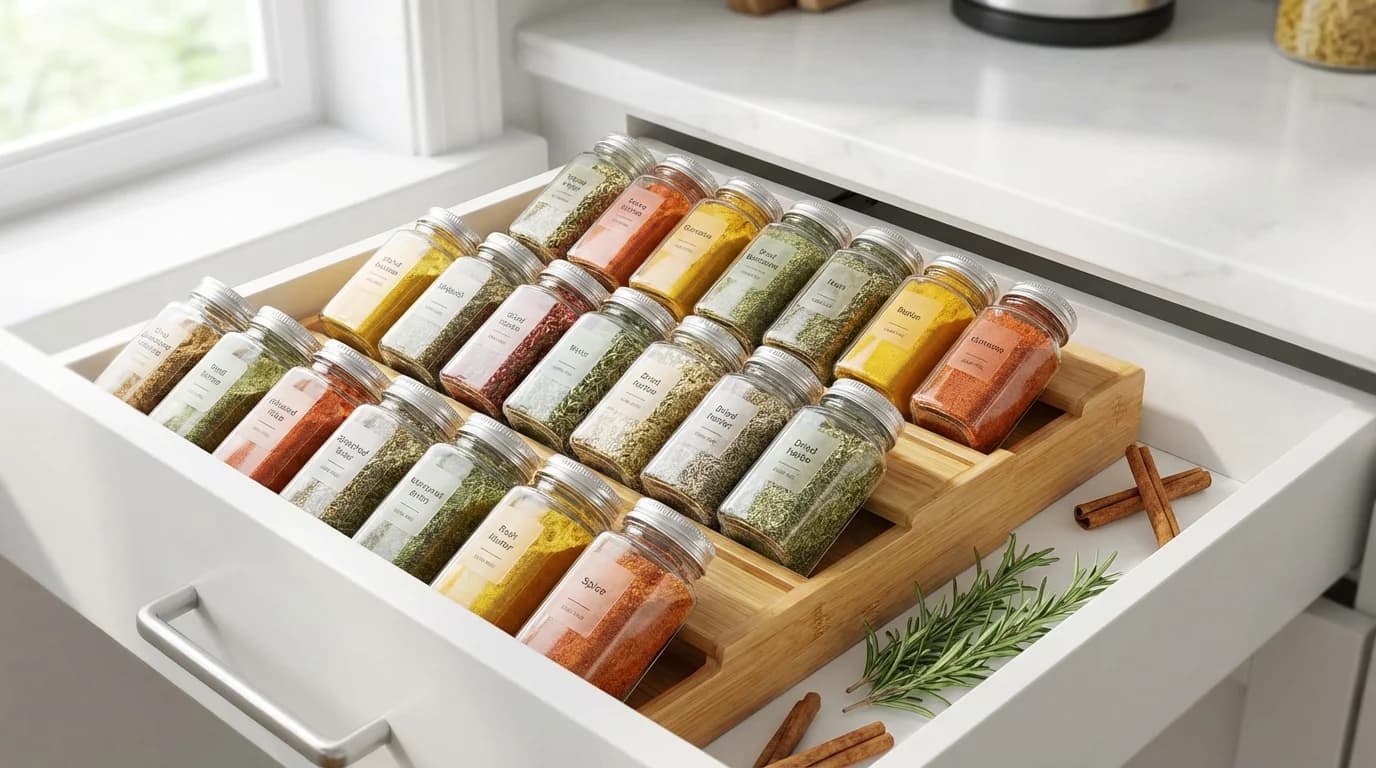
Option 1: Drawer Organization
Best for: Kitchens with available drawer space
Pros:
- Spices lay flat (labels visible)
- Protected from light
- Easy to see entire collection
- Maximizes vertical space
Cons:
- Requires drawer space
- Need specific organizers
How to implement:
- Measure drawer: Width, depth, height
- Choose organizer:
- Drawer inserts with angled tiers
- Expandable bamboo organizers
- DIY cardboard dividers
- Arrange spices:
- Lay bottles flat, labels facing up
- Organize alphabetically or by frequency of use
- Front tier: most-used spices
- Back tier: occasional spices
Product recommendations:
- YouCopia SpiceStack: 30-bottle organizer ($25-40)
- SimpleHouseware Spice Rack: Expandable bamboo ($20-30)
- DIY option: Cut cardboard to create tiers (free)
Budget: $0-40
Option 2: Cabinet Door Storage
Best for: Limited counter/drawer space
Pros:
- Uses wasted door space
- Keeps spices hidden
- Easy access
- Frees up shelf space
Cons:
- Weight limit on doors
- May not fit all cabinet doors
- Can interfere with shelves
How to implement:
- Measure door: Ensure clearance when closed
- Choose rack:
- Command strip mount (no drilling)
- Screw-mount (more secure)
- Multiple tiers
- Install: Follow directions carefully
- Arrange: Most-used at eye level
Product recommendations:
- Lynk Over Cabinet Door Organizer: No drilling ($20-30)
- SimpleHouseware Door Mount: Adjustable ($15-25)
- Copco Non-Skid Cabinet Organizer: Smaller collection ($10-15)
Budget: $10-30
Option 3: Pull-Out Cabinet Organizer
Best for: Deep cabinets, larger collections
Pros:
- Maximizes cabinet depth
- All spices visible when pulled out
- Professional look
- Holds large collection
Cons:
- More expensive
- Requires installation
- Takes entire cabinet
How to implement:
- Measure cabinet: Width and depth
- Choose pull-out: Match dimensions
- Install: May need professional help or DIY skills
- Organize: By category or alphabet
Product recommendations:
- Rev-A-Shelf Pull-Out: Multiple sizes ($50-100)
- Lynk Professional Roll-Out: Adjustable ($60-90)
Budget: $50-100 plus potential installation
Option 4: Countertop Spice Rack
Best for: Avid cooks, small collections, renters
Pros:
- Easy access while cooking
- No installation
- Portable
- Attractive display
Cons:
- Takes counter space
- Spices exposed to light (degrades quality)
- Limited capacity
How to implement:
- Choose location: Near stove but not too close (heat damages spices)
- Select rack:
- Tiered shelf
- Lazy Susan
- Magnetic wall-mount
- Floating shelves
- Arrange: Most-used in front
Product recommendations:
- Copco Lazy Susan: 2-tier turntable ($15-25)
- SimpleHouseware Tiered Shelf: 3-tier bamboo ($12-20)
- Magnetic spice jars with metal wall strip: Modern look ($30-50)
Budget: $12-50
Option 5: Wall-Mounted Solutions
Best for: Renters, small kitchens, display
Pros:
- Uses vertical wall space
- Easy visibility
- Decorative element
- Multiple styles
Cons:
- Requires wall space
- Spices exposed to light
- May need drilling
How to implement:
- Find wall space: Near cooking area
- Choose method:
- Floating shelves
- Magnetic strips
- Mounted racks
- Command strips for renters
- Install securely
- Arrange attractively
Product recommendations:
- IKEA BEKVAM spice racks: Budget shelves ($4-6 each)
- Gneiss Spice Magnetic Jars: Modern look ($60-100 complete set)
- Rustic wooden spice shelf: DIY or Etsy ($20-40)
Budget: $10-100 depending on style
Option 6: Pantry Integration
Best for: Large spice collections, pantry owners
Pros:
- Part of larger organization system
- Out of sight
- Cool, dark storage (best for freshness)
- Room to grow collection
Cons:
- Less convenient for active cooking
- Need organized pantry
How to implement:
- Designate shelf or section: Eye-level preferred
- Use risers or tiers: See bottles behind front row
- Categorize: Baking, savory, blends, etc.
- Label clearly
Organization Methods
Once you choose storage location, decide on arrangement system.
Method 1: Alphabetical
Pros:
- Easy to find any spice
- Family members can navigate
- No thinking required
Cons:
- Related spices separated (cinnamon far from nutmeg)
- Doesn't reflect usage frequency
Best for: Large collections, multiple cooks
Method 2: Frequency of Use
Pros:
- Most efficient for primary cook
- Reduces reaching and searching
- Natural for many people
Cons:
- Less intuitive for others
- May change over time
Best for: Single cook, small to medium collections
Setup:
- Front/Top tier: Daily use (salt, pepper, garlic powder)
- Middle tier: Weekly use (cumin, paprika, oregano)
- Back/Bottom tier: Occasional (specialty spices)
Method 3: By Cuisine
Pros:
- Helpful for recipe following
- Inspires themed cooking
- Logical grouping
Cons:
- Some spices used in multiple cuisines
- Requires more space
Best for: Adventurous cooks, large collections
Groups:
- Italian: Basil, oregano, Italian seasoning, red pepper flakes
- Mexican: Cumin, chili powder, coriander, cayenne
- Asian: Ginger, five-spice, star anise
- Indian: Curry, turmeric, garam masala, cardamom
- Baking: Cinnamon, nutmeg, cloves, vanilla
Method 4: By Type
Pros:
- Logical categories
- Easy to shop and inventory
- Professional organization
Cons:
- May not reflect cooking habits
Best for: Organized personalities, complete collections
Categories:
- Salts: Kosher, sea salt, flavored salts
- Peppers: Black, white, red, specialty
- Herbs: Basil, oregano, thyme, rosemary, parsley
- Ground spices: Cumin, coriander, turmeric, paprika
- Whole spices: Peppercorns, cinnamon sticks, star anise
- Blends: Italian, curry, taco, everything bagel
Hybrid Method:
Combine approaches:
- Most-used in front (frequency)
- Within sections, alphabetize
- Or: Separate by sweet/savory, then alphabetize each
Container Choices
Uniform containers create professional, organized look.
Option 1: Keep Original Jars
Pros:
- Free
- Already labeled
- No transfer work
Cons:
- Different sizes create chaos
- Labels face different directions
- Odd shapes don't stack well
Best for: Budget-conscious, smaller collections
Improvement hack: Remove original labels, relabel uniformly on top
Option 2: Transfer to Uniform Jars
Pros:
- Clean, uniform appearance
- Stackable
- Custom labels
- Looks professional
Cons:
- Upfront cost
- Time to transfer
- Need to label
Best for: Pinterest-lovers, large collections, long-term investment
Container options:
Square glass jars ($20-40 for 24):
- Stack efficiently
- See contents
- Dishwasher safe
- Most professional look
Round glass jars ($15-30 for 24):
- Classic look
- Slightly less space-efficient
- Easy to scoop from
Plastic spice jars ($10-20 for 24):
- Lightweight
- Won't break
- Budget-friendly
- Won't shatter if dropped
Magnetic tins ($30-60 for 24):
- Cool modern look
- Stick to magnetic surface
- See-through top
- Space-saving
Product recommendations:
- Simple Houseware Spice Jars: Glass, 24-pack ($25-35)
- Talented Kitchen Spice Containers: Square, labels included ($30-40)
- Gneiss Spice Magnetic Jars: Premium option ($60-100)
- Dollar Tree small jars: Budget DIY ($12 for 24)
Size Considerations:
4 oz jars: Most common, fits standard spice quantities 2 oz jars: Specialty spices used sparingly 6-8 oz jars: Frequently used (garlic powder, cinnamon)
Pro tip: Buy multi-size pack to accommodate different needs
Labeling Systems
Uniform labels transform organization from functional to beautiful.
Option 1: Printed Labels
Free templates: Download and print on regular or label paper
How to:
- Find free template online or create in Word
- Print on label sheets or cardstock
- Cut and apply
- Optional: Laminate for durability
Budget: $5-10 for label sheets
Option 2: Label Maker
Pros:
- Professional look
- Durable
- Reusable label maker
- Consistent sizing
Cons:
- Initial investment
- Tape costs
How to:
- Purchase label maker ($20-40)
- Create labels for each spice
- Apply to jar tops or sides
- Organized and clear
Budget: $25-50 initial investment
Option 3: Chalkboard Labels
Pros:
- Reusable
- Rustic/cute aesthetic
- Easy to change
Cons:
- Can smudge
- Need chalk marker
- More casual look
How to:
- Buy chalkboard label stickers ($5-10)
- Apply to jars
- Write with chalk marker
- Erase and rewrite as needed
Budget: $8-15
Option 4: Handwritten
Pros:
- Free
- Personal touch
- No equipment needed
Cons:
- Less uniform
- May be hard to read
- Less durable
How to:
- Use masking tape or labels
- Write with permanent marker
- Replace when faded
Budget: $0-3
What to Include on Labels:
Minimum: Spice name
Recommended:
- Spice name
- Purchase/transfer date
- Expiration date
Optional:
- Common uses
- Pairing suggestions
- Heat level (for peppers)
Label placement:
- Top of jar: Best for drawer storage (label visible when looking down)
- Side of jar: Best for shelf storage (label visible from front)
- Both: Maximum visibility in any storage
Maintaining Your Spice Organization
Organization fails without maintenance systems.
Monthly Check (5 minutes):
- Return misplaced spices to correct spots
- Wipe up any spills
- Quick smell test on opened spices
- Make shopping list for depleted spices
Quarterly Inventory (15 minutes):
- Check expiration dates
- Toss or donate unused spices
- Reorganize if system isn't working
- Deep clean organizer/drawer
Annual Refresh (30 minutes):
- Complete purge of expired spices
- Deep clean all containers
- Reassess organization system
- Replace any worn organizers
Shopping Tips:
Buy small quantities: Especially for new or specialty spices Bulk bins: Great for trying new spices cheaply Check dates: Choose freshest at store Track usage: Don't buy huge containers of rarely-used spices
Freshness Tips:
Storage location:
- Avoid: Above stove (heat), next to oven, sunny windowsill
- Ideal: Cool, dark, dry location
- Best: Away from heat and light sources
Container requirements:
- Airtight seal
- Opaque or dark glass (protects from light)
- Clean and dry
Extend shelf life:
- Buy whole spices, grind as needed (last 3x longer)
- Store in freezer (especially red spices like paprika, chili powder)
- Write date on all spices
- Smell test before using in special dishes
Budget-Friendly Organization Ideas
Transform your spice situation without spending much.
Free/Under $10:
Shoe box drawer dividers: Cut boxes to create sections Test tube rack: Holds spice jars perfectly (check thrift stores) Magnetic strips + magnetic tins: Dollar store finds Masking tape labels: Write with marker Tiered cardboard risers: DIY from boxes
$10-30:
Dollar store bins and risers: Create custom drawer system Basic spice rack: Simple 3-tier shelf Over-door organizer: Fits most cabinets Label maker: One-time investment with lasting use Lazy Susan: From dollar store or Target
$30-60:
Complete set of matching jars: 24 jars with labels Quality drawer insert: Custom fit Wall-mounted shelf system: IKEA spice racks Magnetic jars with strip: Modern countertop solution
Common Spice Organization Mistakes
Mistake 1: Storing Near Heat
Problem: Heat degrades spices quickly Solution: Move away from stove, oven, dishwasher
Mistake 2: Exposure to Light
Problem: Light fades color and flavor Solution: Use dark jars or closed cabinet storage
Mistake 3: Buying Large Containers
Problem: Spices expire before use Solution: Buy small quantities, especially for new spices
Mistake 4: No Labeling System
Problem: Can't find spices, forget what they are Solution: Label everything clearly
Mistake 5: Keeping Ancient Spices
Problem: Old spices add no flavor, take up space Solution: Regular purging, date labeling
Your Spice Organization Action Plan
Step 1: Afternoon 1 (1-2 hours)
- Remove all spices
- Purge expired and unused
- Clean storage area
- Decide on organization system
Step 2: Shopping (30 minutes)
- Measure space
- Buy necessary organizers
- Get labels and markers
- Purchase fresh versions of purged essentials
Step 3: Afternoon 2 (1-2 hours)
- Set up organizer/system
- Transfer to uniform containers (if chosen)
- Label everything
- Organize by chosen method
Step 4: Maintenance (ongoing)
- Return spices after cooking
- Monthly check
- Quarterly deep organization
- Annual purge
Conclusion
An organized spice collection transforms your cooking experience. No more frantic searching, expired waste, or duplicate purchases. With just a small investment of time and money, you'll create a system that makes cooking faster, easier, and more enjoyable.
The best system is the one you'll maintain. Choose organization methods and storage that fit your kitchen, cooking style, and aesthetic preferences. Start this weekend—your future cooking self will thank you every single time you reach for that perfectly organized cumin.
Ready to organize more of your kitchen? Check out our guides on pantry organization, kitchen decluttering, and our essential kitchen tools list to create a completely organized, functional cooking space.
About myrecipe
myrecipe helps families save, organize, and share their favorite recipes in one place. Plan meals, create shopping lists, and preserve your culinary traditions.
Start Organizing Recipes