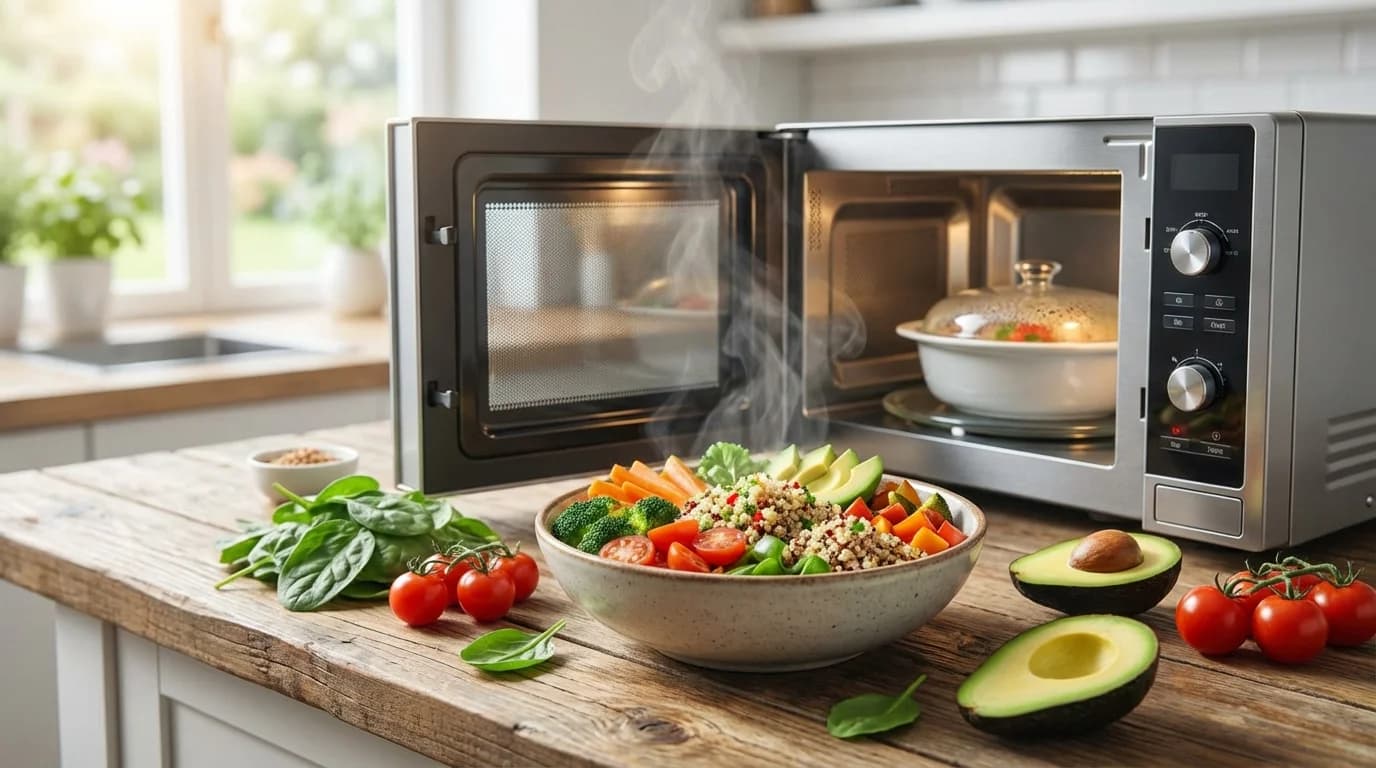
When you think "microwave meal," you probably picture a sad frozen dinner or last night's leftovers. But your microwave is capable of so much more than reheating. It's a legitimate cooking appliance that can steam vegetables, poach eggs, cook grains, and even make complete healthy meals from scratch.
Key Takeaways
- Microwaves cook food, not just reheat it—you can make complete meals from scratch
- Microwave cooking preserves more nutrients than boiling and uses less energy than ovens
- Perfect for dorms, offices, hotel rooms, and nights when you can't face dishes
- Most recipes cook in 5-10 minutes with minimal cleanup
Whether you're a college student with only a microwave in your dorm, an office worker tired of expensive takeout, or someone who just wants dinner without heating up the kitchen, microwave cooking is faster, easier, and healthier than you think.
In this guide, you'll discover 20 healthy microwave meals that prove you can eat well without a stove, oven, or pile of dishes—just a microwave and a few simple ingredients.
Why Microwave Cooking is Better Than You Think
Microwaves have a reputation problem. They're associated with convenience food, not real cooking. But the science tells a different story.
The actual benefits:
- Nutrient retention: Microwaving vegetables preserves more vitamins than boiling or steaming (shorter cook time = less nutrient loss)
- Energy efficiency: Uses 50-80% less energy than conventional ovens
- Speed: Most meals cook in 5-10 minutes vs. 30-60 minutes in an oven
- Minimal cleanup: One microwave-safe container vs. multiple pots and pans
- No heat: Doesn't heat up your kitchen in summer
The microwave myths debunked:
| Myth | Reality |
|---|---|
| Microwaves destroy nutrients | Actually preserves MORE nutrients than boiling ✓ |
| Microwave cooking isn't "real" cooking | Microwaves cook via heat, just like stoves ✓ |
| Microwaved food tastes bad | Technique matters—proper cooking yields good results ✓ |
| Microwaves are only for reheating | Can steam, poach, bake, and make complete meals ✓ |
| It's unsafe to cook in plastic | Microwave-safe containers are tested and safe ✓ |
The key to good microwave cooking is understanding that microwaves cook from the outside in and heat unevenly. This means you need to stir halfway through, use microwave-safe covers to trap steam, and let food rest to finish cooking.
Microwave Cooking Essentials
Equipment You Need
You don't need fancy gadgets, but having the right containers makes everything easier.
| Item | Why You Need It | Cost |
|---|---|---|
| Microwave-safe bowl with lid | Traps steam for even cooking | $10-15 ✓ |
| Microwave-safe plate | For covering bowls without lids | $5 ✓ |
| Glass measuring cup | For liquids and sauces | $8 ✓ |
| Microwave egg cooker (optional) | Makes perfect eggs every time | $10 |
| Silicone steamer bag | For vegetables | $12 |
What makes containers microwave-safe:
- Glass: Always safe (Pyrex, mason jars)
- Ceramic: Safe if unglazed or labeled microwave-safe
- Plastic: Only if labeled "microwave-safe"—avoid old containers
- Paper: Safe for short cooking (paper towels, parchment)
- Metal: NEVER—causes sparks and fire
Basic Techniques
1. Covering for Steam
- Always cover food with a microwave-safe lid or plate
- Leave a small vent for steam to escape
- Steam is what cooks food evenly in the microwave
2. Stirring Halfway
- Microwaves heat unevenly (hot and cold spots)
- Stirring halfway redistributes heat
- Especially important for liquids and grains
3. Power Levels
- High (100%): Boiling water, reheating liquids
- Medium-High (70-80%): Cooking most foods
- Medium (50%): Defrosting, gentle cooking
- Low (30%): Softening butter, warming bread
4. Resting Time
- Food continues cooking after the microwave stops
- Let dishes rest 1-2 minutes covered
- This prevents overcooking and allows temperature to equalize
20 Healthy Microwave Meals
Quick Proteins (5-8 Minutes)
1. Microwave Scrambled Eggs
- Whisk 2 eggs + 1 tbsp milk in mug
- Microwave 45 seconds, stir, 45 seconds more
- Add cheese, veggies, hot sauce
- Cost per serving: $0.80
2. Poached Egg
- Crack egg into bowl of water
- Microwave 1 minute (check at 45 seconds)
- Perfect for egg bowls or toast
- Cost per serving: $0.30
3. Microwave Salmon
- Place salmon fillet in dish, add lemon and herbs
- Cover, microwave 3-4 minutes (check at 3 min)
- Tender and perfectly cooked
- Cost per serving: $4.50
4. Chicken Breast
- Place chicken breast in dish with 2 tbsp broth
- Cover, microwave 5-6 minutes, flipping halfway
- Check internal temp reaches 165°F
- Cost per serving: $2.50
5. Turkey Meatballs
- Form turkey + breadcrumbs + egg + seasonings into balls
- Arrange in circle, microwave 5 minutes
- Serve with marinara and pasta
- Cost per serving: $2.20
Veggie-Forward Meals (5-10 Minutes)
6. Steamed Broccoli with Lemon Garlic
- Broccoli florets + 2 tbsp water in covered bowl
- Microwave 3-4 minutes until tender
- Toss with olive oil, garlic, lemon, parmesan
- Cost per serving: $1.20
7. Baked Sweet Potato
- Pierce sweet potato, microwave 5-7 minutes
- Top with butter, cinnamon, or savory toppings
- Faster than oven, same result
- Cost per serving: $1.00
8. Cauliflower Rice Bowl
- Frozen cauliflower rice + vegetables + soy sauce
- Microwave 4 minutes, stir, 2 minutes more
- Add protein of choice
- Cost per serving: $1.80
9. Ratatouille (Microwave Version)
- Layer zucchini, eggplant, tomatoes, garlic in dish
- Drizzle olive oil, add herbs
- Microwave 8 minutes, stirring halfway
- Cost per serving: $2.40
10. Stuffed Bell Pepper
- Halve bell pepper, fill with cooked rice + beans + cheese
- Microwave 5-6 minutes until pepper softens
- Complete meal in one pepper
- Cost per serving: $1.90
Grain Bowls & One-Dish Meals (8-12 Minutes)
11. Microwave Quinoa Bowl
- Rinse 1/2 cup quinoa, add 1 cup water
- Microwave 6 minutes, stir, 3 minutes more, rest 2 minutes
- Top with roasted vegetables and tahini
- Cost per serving: $1.60
12. Rice and Beans
- Instant rice + canned black beans + salsa + spices
- Microwave 5 minutes
- Add cheese, avocado, sour cream
- Cost per serving: $1.40
13. Microwave Mac and Cheese (From Scratch)
- Uncooked pasta + water + milk in large bowl
- Microwave 8 minutes, stirring every 2 minutes
- Stir in cheddar cheese
- Cost per serving: $1.20
14. Mug Omelette
- Whisk eggs + vegetables + cheese in large mug
- Microwave 2 minutes, stirring every 30 seconds
- Slide onto plate
- Cost per serving: $1.40
15. Microwave Risotto
- Arborio rice + broth + butter + parmesan
- Microwave 9 minutes, stirring every 3 minutes
- Creamy without constant stirring
- Cost per serving: $1.80
Soup & Stew (10-15 Minutes)
16. Egg Drop Soup
- Heat broth 3 minutes, whisk in beaten egg slowly
- Add frozen peas, soy sauce, sesame oil
- Microwave 2 minutes more
- Cost per serving: $1.20
17. Microwave Chili
- Ground beef + canned beans + tomatoes + chili seasoning
- Microwave 8 minutes, stirring every 3 minutes
- Top with cheese and sour cream
- Cost per serving: $2.60
18. Potato and Leek Soup
- Diced potatoes + leeks + broth in large bowl
- Microwave 12 minutes, stirring halfway
- Blend if desired, add cream
- Cost per serving: $1.60
19. Tortilla Soup
- Chicken + salsa + black beans + corn + broth
- Microwave 6 minutes
- Top with tortilla strips, avocado, cheese
- Cost per serving: $2.40
20. Miso Soup with Tofu
- Heat water 3 minutes, whisk in miso paste
- Add cubed tofu + green onions + seaweed
- Microwave 2 minutes
- Cost per serving: $1.20
Never Run Out of Ideas
Save your favorite microwave recipes with myrecipe. Build a "Microwave Meals" collection for dorm, office, or quick dinners.
Start FreeAdvanced Microwave Techniques
Cooking Proteins Perfectly
Microwave cooking proteins requires understanding power and timing to avoid rubbery texture.
Chicken breast technique:
- Pound to even thickness (1 inch)
- Place in shallow dish with 2 tbsp liquid (broth, wine, or lemon juice)
- Cover with vented lid
- Microwave 5 minutes, flip, 2-3 minutes more
- Check internal temp (165°F)
- Rest 2 minutes covered
Fish technique:
- Use medium power (70%) to prevent overcooking
- Cook 3-4 minutes per 6oz fillet
- Fish should flake easily but still be moist
- Lemon and herbs prevent fishy smell
Egg technique:
- Pierce yolks to prevent explosion
- Use 30-second intervals for scrambled eggs
- Add liquid (milk or water) for fluffier texture
Making Rice and Grains
Rice in the microwave is hands-off and foolproof once you know the ratios.
| Grain | Water Ratio | Time | Rest |
|---|---|---|---|
| White Rice | 1:2 | 12 min | 5 min ✓ |
| Brown Rice | 1:2.5 | 18 min | 5 min ✓ |
| Quinoa | 1:2 | 9 min | 2 min ✓ |
| Couscous | 1:1.5 | 5 min | 5 min ✓ |
| Oats (rolled) | 1:2 | 3 min | 1 min ✓ |
Key tips:
- Use a large bowl (grains expand and liquid boils)
- Cover with vented lid or plate
- Stir halfway through cooking
- Let rest covered—this finishes cooking and prevents mushiness
Vegetable Steaming
Microwave steaming preserves more nutrients than boiling and is faster than stovetop steaming.
Universal steaming method:
- Place vegetables in microwave-safe bowl
- Add 2-4 tbsp water
- Cover tightly (traps steam)
- Microwave on high until tender
- Drain and season
Timing guide:
- Broccoli/Cauliflower: 3-4 minutes
- Carrots (sliced): 4-5 minutes
- Green beans: 3-4 minutes
- Asparagus: 2-3 minutes
- Brussels sprouts (halved): 5-6 minutes
- Spinach: 1-2 minutes
Start checking at the minimum time—you can always add more time, but you can't uncook mushy vegetables.
Microwave Meal Prep for the Week
Microwave cooking isn't just for single servings—you can meal prep efficiently too.
Sunday prep strategy:
- Cook grains in bulk: Make 4 cups rice or quinoa (15 minutes in microwave)
- Steam vegetables: Batch steam 3-4 types of vegetables (20 minutes total)
- Cook proteins: Microwave 4-6 chicken breasts or salmon fillets (25 minutes)
- Portion into containers: Mix and match throughout the week
Mix-and-match formula:
- Base: Rice, quinoa, or cauliflower rice
- Protein: Chicken, salmon, eggs, beans
- Vegetables: Broccoli, peppers, carrots, spinach
- Sauce: Teriyaki, pesto, tahini, salsa
Microwave reheating tips:
- Add 1-2 tbsp water before reheating to prevent drying
- Cover with damp paper towel for steam
- Reheat 2-3 minutes, stirring halfway
- Separate ingredients if possible (add fresh greens after heating)
How myrecipe Helps Microwave Cooking
Once you discover which microwave meals work for your lifestyle, you'll want them organized and accessible. No more googling "can I cook chicken in the microwave" at 8pm.
Create a "Microwave Meals" collection in myrecipe. Tag recipes by:
- Cook time (under 5 minutes, 5-10 minutes, 10+ minutes)
- Category (breakfast, lunch, dinner, snacks)
- Equipment (mug, bowl, steamer bag)
- Dietary needs (high-protein, vegetarian, low-carb)
The recipe scaling feature helps when you're cooking for one or need to double a recipe for meal prep. And when you discover a microwave technique that works, save it as a note on the recipe so you remember next time.
Start organizing your microwave recipes free with myrecipe—your dorm room, office, or studio kitchen just got more capable.
Common Mistakes to Avoid
Mistake 1: Using Too Much Power
Why it happens: Defaulting to high power for everything The fix: High power (100%) is for boiling water and reheating. Most cooking should be medium-high (70-80%) to prevent rubbery proteins and uneven cooking. Use power settings like you use stove burner heat.
Mistake 2: Not Covering Food
Why it happens: Not understanding that microwaves cook with steam The fix: Always cover food with a microwave-safe lid or vented plate. Uncovered food dries out and cooks unevenly. The steam created by covering is what cooks food evenly and keeps it moist.
Mistake 3: Cooking Large Portions Unevenly
Why it happens: Trying to cook too much at once The fix: Arrange food in a ring (donut shape) leaving the center empty. The center of the microwave is a cold spot. For multiple items, arrange in a circle, not a pile.
Mistake 4: Not Letting Food Rest
Why it happens: Impatience or not knowing carryover cooking happens The fix: Food continues cooking for 1-2 minutes after the microwave stops. Letting it rest covered prevents overcooking and allows temperature to equalize. Check doneness after resting, not immediately.
Mistake 5: Using Non-Microwave-Safe Containers
Why it happens: Assuming all plastic and ceramic is safe The fix: Only use containers labeled "microwave-safe." Regular plastic can melt and leach chemicals. Some ceramics contain metal that causes sparking. When in doubt, use glass.
Frequently Asked Questions
Yes. Microwaves cook food by causing water molecules to vibrate, creating heat. This is no different than heat from a stove or oven. The radiation is non-ionizing (like radio waves), not harmful ionizing radiation (like X-rays). Microwave-safe containers are tested to ensure they don't leach chemicals.
Yes, but use a meat thermometer to ensure it reaches safe internal temperature (165°F for chicken, 145°F for beef/pork). Meat may not brown in the microwave, but it will cook thoroughly if you follow proper timing and power settings.
Microwaves create standing waves with hot and cold zones. This is why stirring halfway through is essential—it redistributes heat. Rotating turntables help, but stirring is still necessary for even cooking.
Yes! Use a large bowl (pasta expands), cover pasta with 2 inches of water, microwave on high. Timing varies by pasta shape but expect 10-14 minutes. Stir halfway through and test for doneness. The key is using enough water and a large enough container.
No—the opposite is true. Microwaving actually preserves more nutrients than boiling or long oven cooking because of shorter cook times and minimal water. Vitamins like C and B are heat-sensitive, so less cooking time = more retained nutrients.
Conclusion
Microwave cooking is an underrated skill that can save you time, money, and energy—literally and figuratively. Whether you're in a dorm, office, or full kitchen, knowing how to cook complete healthy meals in the microwave gives you flexibility and convenience without sacrificing nutrition.
Key takeaways:
- Microwaves preserve more nutrients than boiling and use less energy
- Always cover food to trap steam and ensure even cooking
- Use medium-high power (70-80%) for most cooking, not full power
- Let food rest 1-2 minutes after cooking for carryover cooking
The 20 recipes in this guide prove that microwave meals can be healthy, delicious, and satisfying. Pick a few favorites, save them to your myrecipe collection, and discover what your microwave can really do.
Ready to organize your microwave recipes? Start free with myrecipe—no credit card required. Quick, healthy, and easier than you think.
About myrecipe
myrecipe helps families save, organize, and share their favorite recipes in one place. Plan meals, create shopping lists, and preserve your culinary traditions.
Start Organizing Recipes